Friday, 19 December 2014

A NEW APPROACH TO POLITICS


Plaid Cymru leader Leanne Wood, First Minister Nicola Sturgeon and leader of the Green party in England and Wales Natalie Bennett have stated that all three parties will unite whenever possible to battle the Westminster parties’ obsession with austerity. Meeting at Westminster the three party leaders said that with no end yet in sight to the failed austerity agenda of the Westminster parties, the General Election next May is an opportunity to change UK politics for the better.
Plaid Cymru leader Leanne Wood said:

"Plaid Cymru and the SNP provide an alternative to Westminster’s promise of austerity and cuts to public services. As the only parties, together with the Greens, to reject the cuts consensus, it is unjustifiable and undemocratic to exclude our three parties from proposed leaders’ debates during the forthcoming UK elections. I reiterate my calls for Plaid Cymru’s inclusion in those debates in order to ensure the people can exercise their right to question and scrutinise all major parties.
"The people of Wales face a real choice at the election. All three Westminster parties are committed to slash and burn economics.

"That means cuts for the sake of cuts rather than balancing the books by investment and spreading opportunities.

"It is likely that there will be another hung parliament after the election. In that scenario, Plaid Cymru could hold the balance of power alongside our colleagues in the SNP.

"Should that happen, Plaid Cymru will seek a rebalancing of power and wealth in the UK: transferring powers away from London to Wales so more of our fate is in our own hands; spreading investment away from the booming City of London to areas in most need of investment.

"If the people of Wales return a strong contingent of Plaid Cymru MPs in May, then Wales will be best placed to secure an outcome to improve the prospects of our people and communities."

First Minister and SNP leader Nicola Sturgeon said:
"There is no end in sight to the Westminster cuts that are already hitting Scotland hard - the Autumn Statement earlier this month set out another £15bn of cuts that are coming our way. Not only will these cuts continue to hit hard-working families, women and the vulnerable hardest – they will also put growth and competitiveness at risk.

"But despite the deeply damaging impacts of failed austerity, the Tories and Labour have made crystal clear their determination to carry on regardless.

"And after four years propping up the Tories, the Lib Dems have no credibility. It is time for a new approach to UK politics - and for our parties to use our influence to bring about progressive change at Westminster.

"Following the referendum in Scotland, the political landscape has changed utterly. The SNP is now the third biggest political party in the UK in terms of membership.

"Last month we sent this message to the BBC, ITV, Sky and Channel 4 - to exclude the SNP, the Greens and Plaid Cymru from general election TV debates would be to wilfully ignore this new political landscape. Put simply, it is just not on.

"Electing a strong group of SNP MPs will ensure that Scotland’s voice is heard at Westminster. Along with Plaid Cymru and the Green Party, we will work to do everything possible to tackle inequality and bring about sustainable economic growth."
Natalie Bennett, leader of the Green Party of England and Wales, said:
"I am delighted to have the chance to catch up with two other female leaders of anti-austerity parties in the UK. Together, we represent, with the Scottish Green Party, a new way of doing politics, a move away from the business-as-usual model of the Tories, Labour and Lib Dems that no longer represents public opinion.

"We are the voice of real change - a voice that must be represented in the leader debates next year.
"The ‘Green surge’ that has seen membership in England and Wales more than double, and Scottish Green Party membership leap more than 625% in 2014 is a sign of the shifting political landscape.

"Collectively the Green parties will be standing in more than 75% of seats in the UK, reflecting the advance of our political philosophy that rejects austerity and believes that everyone should have access to the resources for a decent quality of life, with certainty, without fear, while we all live collectively within the limits of our one planet.

"And in thinking about future financial stability, we have to focus on the reason for our current difficulties, the near-collapse of our fraud-ridden, reckless, over-large financial sector.

"Green MP Caroline Lucas is an outstanding MP. Electing more Greens next year will help to bring about a peaceful revolution in British politics, towards a government that works for the common good, not just for the few."

Thursday, 18 December 2014

PAID IN FULL, PAID IN BLOOD...

When in comes to mining, the people of Wales (and elsewhere) can be said to have paid in full and paid in blood. Coal owners and redevelopers promises can be said to be cheap e.g. I will still respect you in the morning, there are 6,000 jobs related to this development, we will restore the landscape after the open coal mining is finished, etc. That said in both Wales and Scotland (and no doubt other former coal mining areas) the promises in relation to afterwards were no doubt laid on thick.

The actions of a judge who in relation to the responsibility for clearing up afterwards should alarm those communities who are living with on-going open cast coal minin operations or like the residents of north Torfaen have potentially this experience yet to come. The case, which revolved around the collapse of a fraud case also indirectly relates to whether or not a mining firm should accept moral responsibility for restoring two opencast sites.

The Serious Fraud Office had accused six people, including two former directors of the firm, of trying to avoid paying the restoration costs. Celtic Energy transferred ownership of mines at Margam, near Port Talbot, and East Pit in Amman Valley to a firm in the Caribbean. Basically the Judge ruled nothing unlawful had taken place and an attempt to re-open the case back in October failed. When coal extraction ceases companies are obliged to restore opencast sites.

The cost of reinstating the two Welsh sites has been estimated to be around £150m, but less than £10m has been set aside so far. The owner, Oak Regeneration, which just happens to be listed in the British Virgin Islands, says it cannot meet the restoration costs and Neath Port Talbot (NPT) council said it understands the company would go into liquidation if it tried to force payment.

Restoration, after years or noise and pollution, is often linked to questionable post coal extraction developments. Certainly Oak Regeneration has plans on both sites, which include housing at Margam and a hotel at East Pit. As elsewhere, both plans relate to yet more mining, something which has provoked strong local opposition in the past.

Now, none of this should be news - taxpayers (in Scotland) may also be left to carry the can as they may have to cover as much as £62m pounds to restore opencast mines in East Ayrshire should make more than a few people sit up and think. An East Ayrshire Council report written after the collapse of Scottish Coal and Aardvark (TMC) reported that there was not enough money set aside to pay for remedial work to restore the mining sites.

Restoration bonds put up in place to pay for the post open cast mining clear were revealed to be significantly less than the projected cost of the restoration work.Coal Action Scotland campaigners are understandably angered and have accused the council of basically failing to enforce and monitor its own rules. After the financial collapse of both companies, liquidators from KPMG were appointed at Scottish Coal in April and at Aardvark in May.

Aside from lost local jobs, East Ayrshire Council have been examining who will have to pay for cleaning up various opencast sites which were previously operated by the open cast coal mining firms. A report to the council's cabinet in May stated that KPMG estimated that total restoration costs for the East Ayrshire sites were "in the region of £48m to £90m".

The East Ayrshire Council council report noted that the potential value of restoration bonds, which are effectively insurance policies for cleaning up the mines after mining has ceased, were worth around £ 16.1 million pounds for Scottish sites and £ 11.52 million pounds for Aardvark sites. 

Back in 2013 the world market for coal was being flooded by cheap US coal as a knock on effect of the collapse of US gas prices due to fracking. Quite how coal prices will fare in a time (however temporary) when oil prices are crashing is as yet an unknown. When it comes to open cast mining and the post mining clear up operations, the time is long overdue for serious questions to be asked of the pen cast mining companies and their promises.

Wednesday, 17 December 2014

AUSTERITY OR AUSTERITY LITE?

It’s not much of a choice, especially when you consider that by polling day only 40% of the Con Dems cuts will have taken place. Before the Autumn Statement, Plaid warned that the Government’s spending plans for the next parliament would take us back to the 1930s if the proposed reductions in public spending were pushed through.
The Labour party understandably attacked the Tories for their plans to reduce spending on public services to levels not seen since the 1930s, at 35% as a share of GDP. Yet, what should alarm people is that the Labour parties’ economic plans are essentially the same. Labour’s plans would see spending on public services at roughly the same, 37% of GDP – reducing it to a level that we have not seen since the 1930s, a time before the creation of the NHS and when people left school at the age of 14.
If nothing else, this reveals that there is little or no difference between any of the larger Westminster parties, with Labour lumped to the Tories’ ideological plan to shrink the size of the state and intentionally hack at our public services. At the next Westminster general election, the real choice being offered the people of Wales is between the Westminster parties who all offer more austerity and more hardship, or Plaid Cymru - who, in the forthcoming hung parliament where every vote counts, will demand an end to austerity and fight for the need to invest.
Plaid Cymru has set out its plans to increase investment infrastructure by 1% of UK GDP annually. Institutions such as the International Monetary Fund and the Confederation of British Industry have noted that for every £1 invested it produces £2.50 - £3.00 in the real economy. This would be an investment of around £16 billion at a UK level, bringing £800 million to Wales to invest in schools, hospitals, and other works to improve the economy.
This investment would help us to tackle the deficit over a much longer period. Investment is the perfect antidote to the cosy Westminster Parties’ consensus, which seeks to inflict ever greater levels of austerity on our people. Austerity will ensure that places like Wales suffer as they seek to balance the books on the backs of the poor.

Friday, 12 December 2014

MABEY BRIDGE


The announcement that Mabey Bridge has begun a consultation on the planned closure of its business in Station Road, Chepstow, where 150 people work, is shocking, especially as the news has broken just before Christmas. The Welsh Government needs to urgently step up and see what assistance can be given to the firm, especially as a buyer is being sought for its renewables section in Mathern, Chepstow, which employs 180 people. The company's infrastructure section makes highway bridges, railway bridges, footbridges and sign gantries while its renewables division builds wind turbine towers and carries out work in offshore renewable energy, the production of which would help with infrastructure investment and developing the renewable energy sector in Wales.

Thursday, 11 December 2014

WHAT’S THE PRICE A FREE PRESS?

Whether you live in the old West, the old East for the Middle and Far East, the problem of press freedom and the need of an independent free press is universal. The continued consolidation of media outlets, for whatever reason – economic or political – means that there are fewer and fewer independent media outlets. Most people still take their news from the larger, often state or media mogul run, news outlets rather than ‘independent news sources.’ Providing you are aware of the element of ‘spin’ this should not be problem. Yet recent evidence in relation to the scale and weight of spin and the narrowness of news outlets reportage has been provided by the questionable coverage of the Scottish referendum and subsequent political developments. If your message is not popular with the media moguls or the state run (or controlled) media outlets then despite the presence of the internet and social media getting your message out or providing independent scrutiny of governmental decisions is increasingly difficult. What’s going on in Tomsk, in Siberia is typical of what is going on around the world.


----------------------------------------------------------------------------------------------

Independent Siberian TV Channel Faces Shutdown

By Robert Coalson
December 09, 2014
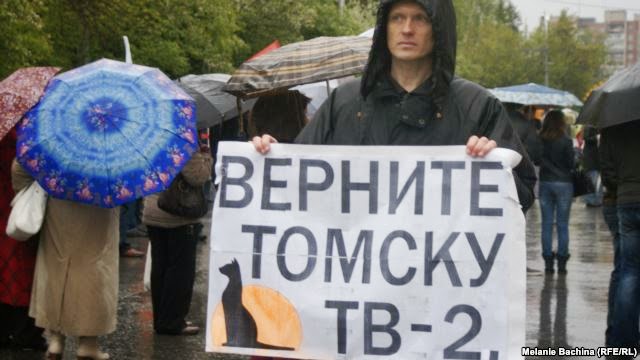
A protester expresses his support for Tomsk TV-2 
When the clock strikes midnight on New Year's Eve this year, audiences in the Siberian city of Tomsk will likely lose a familiar, independent source of information.
Tomsk TV-2, which is widely seen as one of the most respected and professional regional television stations in Russia for the last 23 years, has been informed by the city's state-monopoly television broadcast center that it will cease transmitting the channel's signal as of January 1.
Although the reasons behind the threatened shutoff remain murky, it comes against a background of state pressure against activists, nongovernmental organizations, and nonstate media in Russia by both national and local authorities.
The announcement by the Tomsk Regional Broadcasting Center violates the terms of the contract with TV-2 itself, as well as Russian antimonopoly legislation, says the station's lawyer, Anastasia Olgovskaya.
The station has said it will appeal the decision. But Melani Bachina, a Tomsk TV-2 presenter and producer who is also a freelance correspondent for RFE/RL's Russian Service, says she suspects this may come to nothing.
"No one is trying to be in contact with us," she says. "No one is making any effort to talk to us about anything. No one has given us any argumentation for why this is happening." The lack of any effort to resolve the issue makes her feel the decision to close down TV-2 "has already been made."
Nowhere To Appeal
TV-2 representatives do not know what the reason for the transmission center's decision is, but they are convinced the impetus for the impending closure came from someone else.
"It is perfectly clear that the transmitters are only the middlemen in this, that someone else stands behind this decision," Bachina says. "But who is it? Of course, we have suppositions, but since we have no facts or evidence, there is nothing that we can do and we cannot appeal to those people or to that person."
TV-2 editor Viktor Muchnik agrees. "Our story, like so many stories in our country, is unfortunate in that the person acting against us is anonymous," he says. "We are always dealing with some sort of intermediary who says: 'I don't know anything. They tell me from above what to do and I do it.' We can only guess who is pulling the strings. But I know that the mere existence of this channel over the years has been a problem for many people."
Earlier this year, the transmitter stopped broadcasting TV-2's signal for about six weeks, claiming that some TV-2 equipment had damaged equipment belonging to the transmission tower. That blackout prompted the Russian Justice Ministry's national media register to warn TV-2 that it would lose its license if it did not resume broadcasting. Although the dispute was resolved, activists saw it as a warning to the channel.
Bachina says she has no idea what will become of the station's 300 employees, adding that there is little chance TV-2 could switch to cable or Internet broadcasting.
"The majority of our audience is elderly. They are people who have been watching TV-2 for years," she says. "These are people who, in one way or another, become the subjects of our reports. These are people who do not even have cable TV -- they receive us through terrestrial broadcasting. So, what is the point in talking about switching to the Internet? These people will be deprived of this source of information."
Last Independent Voices
The impending shutdown of Tomsk TV-2 comes against the background of a similar assault by the authorities on the popular independent television channel Dozhd TV. That channel was removed from cable and satellite networks in February and has been forced to ask viewers for payments.
Dozhd has been evicted from its Moscow offices twice in recent months and, according to the BBC on December 8, is currently broadcasting from an employee's residence.
The liberal national radio station Ekho Moskvy was involved in a dispute last month between its journalists and its owner, Gazprom-Media, in which the latter briefly threatened to fire the station's chief editor and revamp its news and talk format.
TV-2 editor Muchnik says independent regional channels are far more vulnerable to the whims of local officials.
"Of course, this is a very bad precedent," Muchnik says. "It is particularly bad because the economic situation in the country is getting worse, tensions are increasing, especially in the regions. Of course, any local official is going to be at odds with any local media that doesn't relate the news according to his script. And this conflict is going to be twice as bad or three times as bad under these growing tensions."
"If this can happen to us, then it can happen anywhere -- in Kuban, in Krasnoyarsk, in Yekaterinburg -- anywhere," he adds.
Written by Robert Coalson on the basis of reporting by RFE/RL's Russian Service and Current TV