Whether you live in the old West, the old
East for the Middle and Far East, the problem of press freedom and the need of
an independent free press is universal. The continued consolidation of media
outlets, for whatever reason – economic or political – means that there are
fewer and fewer independent media outlets. Most people still take their news
from the larger, often state or media mogul run, news outlets rather than
‘independent news sources.’ Providing you are aware of the element of ‘spin’
this should not be problem. Yet recent evidence in relation to the scale and
weight of spin and the narrowness of news outlets reportage has been provided
by the questionable coverage of the Scottish referendum and subsequent
political developments. If your message is not popular with the media moguls or
the state run (or controlled) media outlets then despite the presence of the
internet and social media getting your message out or providing independent
scrutiny of governmental decisions is increasingly difficult. What’s going on
in Tomsk, in Siberia is typical of what is going on around the world.
----------------------------------------------------------------------------------------------
Independent
Siberian TV Channel Faces Shutdown
By Robert Coalson
December 09, 2014
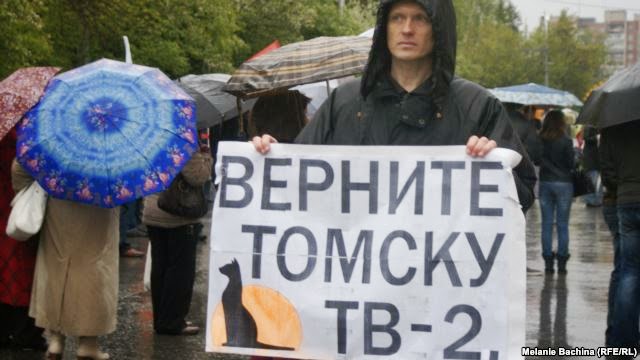 |
| A protester expresses his support for Tomsk TV-2 |
When the clock strikes midnight on New Year's Eve this
year, audiences in the Siberian city of Tomsk will likely lose a familiar,
independent source of information.
Tomsk TV-2, which
is widely seen as one of the most respected and professional regional
television stations in Russia for the last 23 years, has been informed by the
city's state-monopoly television broadcast center that it will cease
transmitting the channel's signal as of January 1.
Although the
reasons behind the threatened shutoff remain murky, it comes against a
background of state pressure against activists, nongovernmental organizations,
and nonstate media in Russia by both national and local authorities.
The announcement
by the Tomsk Regional Broadcasting Center violates the terms of the contract
with TV-2 itself, as well as Russian antimonopoly legislation, says the
station's lawyer, Anastasia Olgovskaya.
The station has
said it will appeal the decision. But Melani Bachina, a Tomsk TV-2 presenter
and producer who is also a freelance correspondent for RFE/RL's Russian
Service, says she suspects this may come to nothing.
"No one is
trying to be in contact with us," she says. "No one is making any
effort to talk to us about anything. No one has given us any argumentation for
why this is happening." The lack of any effort to resolve the issue makes
her feel the decision to close down TV-2 "has already been made."
Nowhere To Appeal
TV-2
representatives do not know what the reason for the transmission center's
decision is, but they are convinced the impetus for the impending closure came
from someone else.
"It is
perfectly clear that the transmitters are only the middlemen in this, that
someone else stands behind this decision," Bachina says. "But who is
it? Of course, we have suppositions, but since we have no facts or evidence,
there is nothing that we can do and we cannot appeal to those people or to that
person."
TV-2 editor
Viktor Muchnik agrees. "Our story, like so many stories in our country, is
unfortunate in that the person acting against us is anonymous," he says.
"We are always dealing with some sort of intermediary who says: 'I don't
know anything. They tell me from above what to do and I do it.' We can only
guess who is pulling the strings. But I know that the mere existence of this
channel over the years has been a problem for many people."
Earlier this
year, the transmitter stopped broadcasting TV-2's signal for about six weeks,
claiming that some TV-2 equipment had damaged equipment belonging to the
transmission tower. That blackout prompted the Russian Justice Ministry's
national media register to warn TV-2 that it would lose its license if it did
not resume broadcasting. Although the dispute was resolved, activists saw it as
a warning to the channel.
Bachina says she
has no idea what will become of the station's 300 employees, adding that there
is little chance TV-2 could switch to cable or Internet broadcasting.
"The majority
of our audience is elderly. They are people who have been watching TV-2 for
years," she says. "These are people who, in one way or another,
become the subjects of our reports. These are people who do not even have cable
TV -- they receive us through terrestrial broadcasting. So, what is the point
in talking about switching to the Internet? These people will be deprived of
this source of information."
Last Independent
Voices
The impending
shutdown of Tomsk TV-2 comes against the background of a similar assault by the
authorities on the popular independent television channel Dozhd TV. That
channel was removed from cable and satellite networks in February and has been
forced to ask viewers for payments.
Dozhd has been
evicted from its Moscow offices twice in recent months and, according to the
BBC on December 8, is currently broadcasting from an employee's residence.
The liberal
national radio station Ekho Moskvy was involved in a dispute last month between
its journalists and its owner, Gazprom-Media, in which the latter briefly
threatened to fire the station's chief editor and revamp its news and talk
format.
TV-2 editor
Muchnik says independent regional channels are far more vulnerable to the whims
of local officials.
"Of course,
this is a very bad precedent," Muchnik says. "It is particularly bad
because the economic situation in the country is getting worse, tensions are
increasing, especially in the regions. Of course, any local official is going
to be at odds with any local media that doesn't relate the news according to
his script. And this conflict is going to be twice as bad or three times as bad
under these growing tensions."
"If this can
happen to us, then it can happen anywhere -- in Kuban, in Krasnoyarsk, in
Yekaterinburg -- anywhere," he adds.
Written by Robert
Coalson on the basis of reporting by RFE/RL's Russian Service and Current TV


