Showing posts with label Ireland. Show all posts

Wednesday, 3 February 2016

HERE WE GO AGAIN


On the 6th February the 6 Nations rugby internationals kick off, rugby fans will prepare themselves for over crowded trains and the usual excuses from the rail franchise holders. On Friday 28thFebruary Wales play France. Rugby fans will face the ordeal of a Friday night international match, with an 8pm kick-off and the logistical perfect storm that awaits them. 

Simply getting to (and from) Cardiff on a Friday evening, with the lack of late trains, and scheduled maintenance – may more than try fans patience. It will be grim for Welsh Rugby fans, travelling south and east to Cardiff before kick-off, but it may be even grimmer afterwards when they try to get home. 

Bitter experience relayed by supporters (and would be rail travellers) tells me that the franchise holders will run short trains, when these trains reach Abergavenny, Pontypool, Cwmbran, Chepstow, Caldicot, Severn Tunnel Junction and Newport (not to mention Hereford, Lydney and Gloucester) they will be so full that passengers cannot board them. 

Prepare for the usual excuses from Arriva Trains Wales as to why this overcrowding problem happens and how it will be avoided next time. The reality is that the short-term rental costs of hiring extra trains would be cost prohibitive. The day the rail franchise moves to a not for dividend profit cannot come soon enough.

Thursday, 11 December 2014

WHAT’S THE PRICE A FREE PRESS?

Whether you live in the old West, the old East for the Middle and Far East, the problem of press freedom and the need of an independent free press is universal. The continued consolidation of media outlets, for whatever reason – economic or political – means that there are fewer and fewer independent media outlets. Most people still take their news from the larger, often state or media mogul run, news outlets rather than ‘independent news sources.’ Providing you are aware of the element of ‘spin’ this should not be problem. Yet recent evidence in relation to the scale and weight of spin and the narrowness of news outlets reportage has been provided by the questionable coverage of the Scottish referendum and subsequent political developments. If your message is not popular with the media moguls or the state run (or controlled) media outlets then despite the presence of the internet and social media getting your message out or providing independent scrutiny of governmental decisions is increasingly difficult. What’s going on in Tomsk, in Siberia is typical of what is going on around the world.


----------------------------------------------------------------------------------------------

Independent Siberian TV Channel Faces Shutdown

By Robert Coalson
December 09, 2014
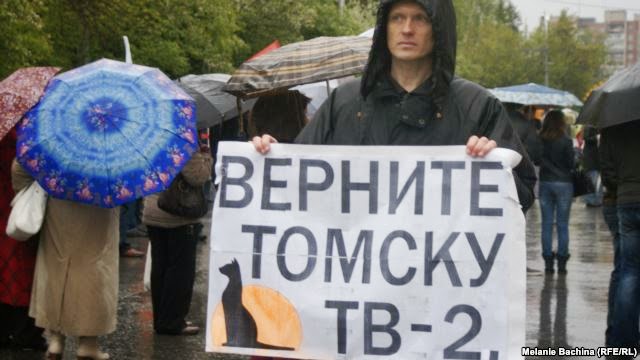
A protester expresses his support for Tomsk TV-2 
When the clock strikes midnight on New Year's Eve this year, audiences in the Siberian city of Tomsk will likely lose a familiar, independent source of information.
Tomsk TV-2, which is widely seen as one of the most respected and professional regional television stations in Russia for the last 23 years, has been informed by the city's state-monopoly television broadcast center that it will cease transmitting the channel's signal as of January 1.
Although the reasons behind the threatened shutoff remain murky, it comes against a background of state pressure against activists, nongovernmental organizations, and nonstate media in Russia by both national and local authorities.
The announcement by the Tomsk Regional Broadcasting Center violates the terms of the contract with TV-2 itself, as well as Russian antimonopoly legislation, says the station's lawyer, Anastasia Olgovskaya.
The station has said it will appeal the decision. But Melani Bachina, a Tomsk TV-2 presenter and producer who is also a freelance correspondent for RFE/RL's Russian Service, says she suspects this may come to nothing.
"No one is trying to be in contact with us," she says. "No one is making any effort to talk to us about anything. No one has given us any argumentation for why this is happening." The lack of any effort to resolve the issue makes her feel the decision to close down TV-2 "has already been made."
Nowhere To Appeal
TV-2 representatives do not know what the reason for the transmission center's decision is, but they are convinced the impetus for the impending closure came from someone else.
"It is perfectly clear that the transmitters are only the middlemen in this, that someone else stands behind this decision," Bachina says. "But who is it? Of course, we have suppositions, but since we have no facts or evidence, there is nothing that we can do and we cannot appeal to those people or to that person."
TV-2 editor Viktor Muchnik agrees. "Our story, like so many stories in our country, is unfortunate in that the person acting against us is anonymous," he says. "We are always dealing with some sort of intermediary who says: 'I don't know anything. They tell me from above what to do and I do it.' We can only guess who is pulling the strings. But I know that the mere existence of this channel over the years has been a problem for many people."
Earlier this year, the transmitter stopped broadcasting TV-2's signal for about six weeks, claiming that some TV-2 equipment had damaged equipment belonging to the transmission tower. That blackout prompted the Russian Justice Ministry's national media register to warn TV-2 that it would lose its license if it did not resume broadcasting. Although the dispute was resolved, activists saw it as a warning to the channel.
Bachina says she has no idea what will become of the station's 300 employees, adding that there is little chance TV-2 could switch to cable or Internet broadcasting.
"The majority of our audience is elderly. They are people who have been watching TV-2 for years," she says. "These are people who, in one way or another, become the subjects of our reports. These are people who do not even have cable TV -- they receive us through terrestrial broadcasting. So, what is the point in talking about switching to the Internet? These people will be deprived of this source of information."
Last Independent Voices
The impending shutdown of Tomsk TV-2 comes against the background of a similar assault by the authorities on the popular independent television channel Dozhd TV. That channel was removed from cable and satellite networks in February and has been forced to ask viewers for payments.
Dozhd has been evicted from its Moscow offices twice in recent months and, according to the BBC on December 8, is currently broadcasting from an employee's residence.
The liberal national radio station Ekho Moskvy was involved in a dispute last month between its journalists and its owner, Gazprom-Media, in which the latter briefly threatened to fire the station's chief editor and revamp its news and talk format.
TV-2 editor Muchnik says independent regional channels are far more vulnerable to the whims of local officials.
"Of course, this is a very bad precedent," Muchnik says. "It is particularly bad because the economic situation in the country is getting worse, tensions are increasing, especially in the regions. Of course, any local official is going to be at odds with any local media that doesn't relate the news according to his script. And this conflict is going to be twice as bad or three times as bad under these growing tensions."
"If this can happen to us, then it can happen anywhere -- in Kuban, in Krasnoyarsk, in Yekaterinburg -- anywhere," he adds.
Written by Robert Coalson on the basis of reporting by RFE/RL's Russian Service and Current TV

Saturday, 16 August 2014

FINISHED WITH THE WAR

It’s important to remember that the First World War was divisive from day one, people had different opinions on the war then as well as now, both at home and at the front. While pacifists and some politicians opposed the war on principle (there were some well managed high level resignations and heated debate within the Cabinet in the days before the war began) they were not alone in questioning the validity of the war.

Save for Lloyd George’s barely concealed political opportunism there was a real possibility that Britain’s entry into the conflict might have been delayed or may well might never have taken place at all. For many people the principle of Belgium’s independence was enough, it was certainly enough for the Cabinet, combining both principal and political expediency. 

The war in Europe meant that the UK Government could avoid a civil war in Ireland over Home Rule. It also touched upon a genuine and historic English strategic necessity - that of preserving Belgium’s independence fulfilled a long term strategic necessity in relation to control of Flanders. The problem was that war of Belgium’s independence became almost inevitably war over other things especially other peoples Empires.  


The war that most of the volunteers signed up to fight in 1914 and 1915 was not the war they ended up fighting, it became something else, something that prompted Siegfried Sassoon (the Poet) and a decorated serving soldier (in July 1917)  to send  a letter entitled ‘Finished with the War: A Soldiers Declaration’ which ended up being published in The Times (and other newspapers) and read out in the House of Commons, he wrote:

I am making this statement as an act of wilful defiance of military authority because I believe that the war is being deliberately prolonged by those who have the power to end it. I am a soldier, convinced that I am acting on behalf of soldiers. I believe that the war upon which I entered as a war of defence and liberation has now become a war of agression and conquest. I believe that the purposes for which I and my fellow soldiers entered upon this war should have been so clearly stated as to have made it impossible to change them and that had this been done the objects which actuated us would now be attainable by negotiation.

I have seen and endured the sufferings of the troops and I can no longer be a party to prolong these sufferings for ends which I believe to be evil and unjust. I am not protesting against the conduct of the war, but against the political errors and insincerities for which the fighting men are being sacrificed.

On behalf of those who are suffering now, I make this protest against the deception which is being practised upon them; also I believe it may help to destroy the callous complacency with which the majority of those at home regard the continuance of agonies which they do not share and which they have not enough imagination to realise.

Sassoon (Who had been awarded the Military Cross) narrowly escaped courts martial, was declared unfit for service and treated for shell shock. Yet he returned to the front (as did his fellow poet Wilfred Owen) where he was wounded in August 1918. The letter, which is still powerful even today, should remind us that despite the image presented by the commemoration ceremonies people’s attitudes to the war were not uniform even amongst serving soldiers. 

We should not diminish or cheapen the memories of those who fought, who served, who survived and who died by simplifying them or hiding the reasons (both complex and simple) as to why people served and fought or chose not to. Neither should we gloss over the exceptionally poor statesmanship and the bad decisions made by the ruling elites that plunged Europe (and other parts of the world) into four years of bloody conflict the legacies of which are still with us today.  

Thursday, 6 December 2012

WAITING FOR THE GLIMMER MAN...

Yesterday we were waiting with no particular degree of anticipation for Chancellor George Osborne to inform MPs (and the rest of us) that there was no "no miracle cure" to the UK's economic woes in his Autumn Statement. The Chancellor made his statement against a pretty grim economic background when compared with his budget forecast made last March in the Budget. Mr Osborne continued to state that the coalition was continuing to "confront the country's problems" and was hard at work reducing the deficit.

The cancellation of the proposed 3 pence a litre increase in fuel duty may help a little and the  extra £227 million pounds for capital projects is useful it does little to redress fair funding for Wales. When it comes to growth being predicted to be -0.1% in 2012, down from the 0.8% prediction in the Budget in March we are truly in the realm of old style Soviet economic statistics. I suspect that some of the Con Dems (the Cons rather than the Dems I suspect) actually believe that austerity is the answer to the economic disaster left behind by Gordon Brown (and New Labour).

The party formerly known as New Labour predictably called the government's economic policy "a terrible failure” not that they would have done anything different if Gordon had managed to pull the electoral fat out of the fire back in 2010. What’s pretty clear from all of this is that the Con Dems are out of ideas, there was not really a Plan A, so there is little likelihood of a Plan B and clearly no desire to sort out the ongoing UK’s problem with tax evasion. So much for being all in it together.

Almost unnoticed by the UK’s self Anglo centric media the Irish Government presented its sixth austerity budget since the banking and economic collapse. Tax rises and spending cuts were announced as the government aims to save another 3.5 billion euro (around £2.8 billion). All of the so called economic "low-hanging fruit" has been picked clean after four harsh years of austerity. A new property tax (set at 0.18% of the value of a home up to 1 million euros (£800,000 pounds or $1.3 million dollars) and cuts to the health and social welfare budgets are planned.

Since 2010, Ireland, following an international bailout, has been forced to follow strict spending limits set by the EU and International Monetary Fund. The Irish government stated that it would meet its deficit reduction target for 2012 and that it  projected a budget deficit of 8.2%, compared with a target of 8.6%. Therefore the deficit would continue to fall steadily to 2.9% by 2015, it added. Irish economic forecasts (unlike on this side of the Irish Sea) were based on economic growth of 1.5% in 2013, rising to 2.9% growth by 2015.

Ireland is no Greece and while it has been riot it has not been protest free. The evident anger (if not quiet rage) at the bankers and the elites abject criminality and sheer folly may have been sidelined at the prospect, after hard years, by some light at the end of Ireland's dark economic tunnel, but, I suspect that it won’t be forgotten. Despite some economic glimmers  there are still plenty of people across the Celtic Sea who are less than happy with the choices made by the Irish elite and the fact that they have largely got away without punishment for their crimes, misdemeanour's and bad decisions.

There have been calls for a new republic and a fresh start literally writing off the past (and the debt) in a simular manner to Iceland. in ‘Towards a Second Republic’, Peadar Kirby and Mary Murphy exposed the winners and losers from the current Irish model of development and related the distributional outcomes of the use of power by Irish elites. It’s analysis of Ireland's economics, politics and society, draws some important lessons from its cycles of boom and bust. They also look at the role of the EU and compare Ireland's crisis and responses to those of other states.

The book (which is well worth a read) also includes proposals to construct new and more effective institutions for the economy and society are also included. Considering (somewhat closer to home) that  there have been no real consequences (or punishments for that matter) for the banking crash for the inhabitants of the Westminster village or the bankers (save for the loss of the odd bonus), I suspect that it won't be on the Christmas reading list of any elite reasonably near here.