While I am having a good Christmas with families, friends and loved ones, I am missing out on football due to waterlogged pitches with the County fixtures at Rodney Parade v Barking (on the 22nd) and Hereford (away at Edgar Street) on the 29th December falling victim to the rain. Honestly there is only so much Borgen you can watch! One belated Christmas present that did arrive was a good away win for Swansea City at Fulham, hopefully a few more wins will follow shortly. Cardiff City remain on top of the Championship, hopefully they will join Swansea in the premiership.
Newport county and Wrecsam remain (at present) respectively second and third in the Blue Square Premier (both sides meet at 7.45pm on Friday 4th January (at Rodney Parade). Football tribalism aside I want success for the other Welsh football clubs (and Welsh football period). I want to see Swansea City do well this season, and Cardiff City join them (preferably not via the play-offs) in the Premiership next season. I want to see Newport County (as Champions) and Wrecsam (as play-off winners) promoted as Champions from the Blue Square Conference this season. I hope that Colwyn Bay manage to stay in Blue Square North and see no reason why Merthyr Town can also not get promoted again this season.
Reguardless of the code, sporting success on the field is difficult enough but made more difficult by the economic situation, which hits costs and attendances. What would be nice would be better all round media coverage for Welsh football (outside of the Premiership and the Championship) for the rest of us. S4C’s Sgorio does an excellent job on Monday evenings but BBC Wales despite a significant improvement in recent months, could do better. Better media coverage would be good for the game in general and the clubs specifically. Here's hoping that the second half of the County's season continues as it has in the first half.
My optimism (the sporting kind) goes beyond the round ball game to rugby and I am ever hopeful (being a season ticket holder) that the Gwent Dragons (“Don't pass the ball to opposition players and kick it between the posts, not past them”) and Newport RFC will turn the corner between now and the end of the season. At a regional level I think that we need central contracting with the WRU running the show, with four regions along the Irish model - while they may not know it - the time of big egos and big moneymen has passed.
Sunday, 30 December 2012


Saturday, 22 December 2012
CUT SEVERN BRIDGE TOLL TO £2
A Plaid Cymru government would begin working now to significantly reduce tolls on the Severn Bridges and to make the statement that Wales is open for business for companies from over the border, said the party’s Shadow Minister for Transport. Rhodri Glyn Thomas has called on the Welsh Government to make the case for responsibility for the bridge to be devolved so that Wales can benefit from it.
Ownership of the bridge will be passed to the Department for Transport when the private company which owns it pays back its debt, which is likely to happen in 2018.
Rhodri Glyn Thomas said that a £2 toll for using the bridge will cover maintenance costs for the bridge. Running costs for the Severn Bridge amount to £15 million a year. Currently, consumers and businesses pay in excess of £72 million every year to cross the bridge.
Party of Wales Shadow Minister for Transport, Rhodri Glyn Thomas said:
“Plaid Cymru has always said that lowering the Severn Bridge tolls would bring huge benefits for the Welsh economy. In 2011 it was our manifesto commitment to reduce the tolls and a Plaid Cymru government would be making the case for that now.
“When the private company relinquishes its ownership of the bridge in 2018, the Welsh Government needs to be ready to step in for the benefit of the people of Wales.
“People travelling home to see their families over Christmas will be charged £6 and businesses with lorries will have to may so much more, and this goes against everything the Welsh Government should be doing to improve the Welsh economy.
“Cutting the toll to cover maintenance would save millions for consumers and businesses and would cost the Welsh Government nothing. The UK Government needs to commit to giving the democratically elected Welsh Assembly control over the bridges so that Plaid Cymru’s economic policy can be implemented in the interest of the people of Wales.”
Ownership of the bridge will be passed to the Department for Transport when the private company which owns it pays back its debt, which is likely to happen in 2018.
Rhodri Glyn Thomas said that a £2 toll for using the bridge will cover maintenance costs for the bridge. Running costs for the Severn Bridge amount to £15 million a year. Currently, consumers and businesses pay in excess of £72 million every year to cross the bridge.
Party of Wales Shadow Minister for Transport, Rhodri Glyn Thomas said:
“Plaid Cymru has always said that lowering the Severn Bridge tolls would bring huge benefits for the Welsh economy. In 2011 it was our manifesto commitment to reduce the tolls and a Plaid Cymru government would be making the case for that now.
“When the private company relinquishes its ownership of the bridge in 2018, the Welsh Government needs to be ready to step in for the benefit of the people of Wales.
“People travelling home to see their families over Christmas will be charged £6 and businesses with lorries will have to may so much more, and this goes against everything the Welsh Government should be doing to improve the Welsh economy.
“Cutting the toll to cover maintenance would save millions for consumers and businesses and would cost the Welsh Government nothing. The UK Government needs to commit to giving the democratically elected Welsh Assembly control over the bridges so that Plaid Cymru’s economic policy can be implemented in the interest of the people of Wales.”
Friday, 21 December 2012
THE POOR BORROW...
Well before the financial collapse, the party formerly known as New Labour (under Blair) signed up to and embraced the agenda of neo liberal capitalism and made its own. Basically neo liberal capitalism aims to restructure government institutions and regulatory bodies so that they embody the logic of the market and see their primary objective as the creation and policing of conditions for the competitive operation of essentially private markets.
The only real spat that New Labour had with George Bush, was when he brought in protective tariffs for the US Steel industry something that would had directly impacted on some of New Labour’s wealthy comrades in arms and fellow travellers. One result of this neo liberal capitalism was that most states in the world ended up with fatally weak redistributive mechanisms, weak financial regulation and a culture of excessive overpayment within banking and financial operations.
In developing countries like China, India and Brazil led to an increase in investors who were seeking opportunities to invest outside of their economies. The US and other financial systems had been deregulated (in the 1980’s); this allowed a virtual explosion of new financial packages to attract internal and overseas investors. The key problem with this was that these new financial packages basically repackaged risk, and sold in a way that much of the risk was pretty much hidden from investors.
One of the largely overlooked side-effects or consequences of the effective abandonment of financial regulation was the explosive growth of investments that aimed to make money out of money which had little or no link to the productive economy. It has been estimated that around 90% of financial transactions had little to do with generating goods, products and services and actual jobs.
What made things worse (potentially) was that even the ratings agencies themselves failed to understand the potential risks that were involved in this process, so the investors stood little change on their own, and a potential financial disaster loomed. The final problem came when the US home mortgage bubble, which had been aggravated by deregulation, was fed by a rapid unsustainable growth in home purchases inside the USA (simular events took place simultaneously in Ireland, Spain and elsewhere).
This led to a growth of debt and decline in savings. When property prices crashed, homeowners were unable to borrow more money against the value of their properties to pay of their debts. The property collapse hit the securities market, which had grown massively on top of home mortgages, as a result some serious financial players, went bust or were propped up by governments using tax payers money.
As a result of the financial collapse is that those institutions that have survived have effectively become risk averse and won’t lend funds to existing or new businesses, thus making the recession worse. What may make things worse for all of us is that all of the Westminster focused political parties have bought into the free market driven economy, which was largely a product (in the UK) of the experience of the winter of discontent (1978 – 1979).
Even though a largely unregulated banking activities brought us the world wide recession / depression there is little talk of effective financial regulation and no assertively expressed alternatives to it. The Westminster elites abject surrender to the City’s money men leaves the most vulnerable in our society at the mercy of the free market, over the twenty years before the crash the rich have got richer (and have continued to do so) and the lower paid have been left with little option but to borrow.
The only real spat that New Labour had with George Bush, was when he brought in protective tariffs for the US Steel industry something that would had directly impacted on some of New Labour’s wealthy comrades in arms and fellow travellers. One result of this neo liberal capitalism was that most states in the world ended up with fatally weak redistributive mechanisms, weak financial regulation and a culture of excessive overpayment within banking and financial operations.
In developing countries like China, India and Brazil led to an increase in investors who were seeking opportunities to invest outside of their economies. The US and other financial systems had been deregulated (in the 1980’s); this allowed a virtual explosion of new financial packages to attract internal and overseas investors. The key problem with this was that these new financial packages basically repackaged risk, and sold in a way that much of the risk was pretty much hidden from investors.
One of the largely overlooked side-effects or consequences of the effective abandonment of financial regulation was the explosive growth of investments that aimed to make money out of money which had little or no link to the productive economy. It has been estimated that around 90% of financial transactions had little to do with generating goods, products and services and actual jobs.
What made things worse (potentially) was that even the ratings agencies themselves failed to understand the potential risks that were involved in this process, so the investors stood little change on their own, and a potential financial disaster loomed. The final problem came when the US home mortgage bubble, which had been aggravated by deregulation, was fed by a rapid unsustainable growth in home purchases inside the USA (simular events took place simultaneously in Ireland, Spain and elsewhere).
This led to a growth of debt and decline in savings. When property prices crashed, homeowners were unable to borrow more money against the value of their properties to pay of their debts. The property collapse hit the securities market, which had grown massively on top of home mortgages, as a result some serious financial players, went bust or were propped up by governments using tax payers money.
As a result of the financial collapse is that those institutions that have survived have effectively become risk averse and won’t lend funds to existing or new businesses, thus making the recession worse. What may make things worse for all of us is that all of the Westminster focused political parties have bought into the free market driven economy, which was largely a product (in the UK) of the experience of the winter of discontent (1978 – 1979).
Even though a largely unregulated banking activities brought us the world wide recession / depression there is little talk of effective financial regulation and no assertively expressed alternatives to it. The Westminster elites abject surrender to the City’s money men leaves the most vulnerable in our society at the mercy of the free market, over the twenty years before the crash the rich have got richer (and have continued to do so) and the lower paid have been left with little option but to borrow.
Thursday, 20 December 2012
THE RIGHT DECISION
 |
| The worst journey in the world |
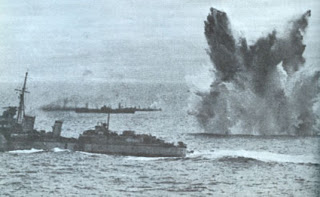
The veterans risked their lives time and time again convoying crucial supplies through often atrocious weather and hostile seas to the hard pressed (then) Soviet Union, which was fighting for survival. The Foreign Office (and the Ministry of Defence) had previously repeatedly (under both Labour and Conservative Governments) blocked this move saying that it would break the rules surrounding acceptance of medals. The Russian Embassy had expressed its 'deep regret' at this decision, which was understandably been condemned by surviving convoy veterans, their families and supporters.
Between August 31, 1941 and May 22, 1945, some 78 Allied Arctic Convoy (more than 1,400 merchant ships escorted by ships of the British, U.S. and Canadian Navies) sailed to the ports of Murmansk and Arkhangelsk. Some 85 merchant vessels and 16 Royal Navy warships were sunk by Nazi submarines and approximately 3,000 British servicemen were killed during the Arctic campaign.
The significance of lend-lease supplies for the Eastern front by Soviet-bound Arctic convoys and their role in defeating fascism is still emerging. The convoy veterans and the vital supplies they delivered were temporarily lost in the often hot rhetoric of the Cold War. Oleg Rzheshevsky, the Russian war historian, has noted that apart from everything else, the convoys were a powerful moral influence.
"The moral aspect of the Arctic Convoys meant a lot. This was an extremely important factor both for the army and for all our people as it signalled that we were not alone in that war but had strong allies such as Britain and the United States. This helped boost our troop morale on the battlefield and supported our people on the home front."
Successive Westminster governments had previously promised to create a medal, yet they all failed to deliver on their promise. The Russian Government has awarded our veterans three medals, the arctic convoys are now part of Russia’s school curriculum. The Russian Government and the Russian people understand the convoy’s importance, yet successive UK Governments seem to really struggle with this, at least until now.
Wednesday, 19 December 2012
PUTTING PARTY BEFORE PUBLIC INTEREST
It will come as no surprise to those who know them that Labour in Wales councillors in Newport have voted against motion to keep free parking in Newport Town centre. So much for the 4,011 people who signed the petition (organised by the South Wales Argus) calling on Newport city council to think again. The Argus reported that Labour in Wales councillor for Gaer, Herbie Thomas, told the council had to stop kidding themselves and that no one shopped in the city centre anymore. He was reported as saying: "The town centre is finished. Let's not kid ourselves anymore. People shop differently now." So much for Labour caring for Newport. On Tuesday evening after some spirited exchanges the motion to oppose the plan to introduce charging for parking was voted down by 32 against and 10 votes (with one Labour abstention).
Tuesday, 18 December 2012
LONG TERM THINKING
In Northern Ireland there is clear evidence of some long term thinking as more than £ 44 million pounds has been approved to boost green energy generation including potentially some 1,000 megawatts of renewable wind generation. Some of the funding will go to improve the transmission network and sub stations. The Northern Ireland Executive has set a target of generating 40% of the Northern Ireland’s energy from renewable sources by 2020.
The Scottish Government revealed its new green energy target set at 50% of demand by 2015. The Scots have already surpassed their 31% target for 2001 by about 4%. The SNP Government has stated that the new target would help build on the current 11,000 jobs in green energy following a "bumper year" for investment, with projects estimated to be worth £2.3 billion pounds.
The Scottish government's new interim target for 2015 is included in a refreshed Routemap for Renewable Energy for Scotland. Sustainable energy generation has been boosted by the launch (in October 2012) of a £103 million pound fund for Scottish renewable energy projects. The Renewable Energy Investment Fund (REIF) is designed to attract more private investment to the sector. Scottish priorities include wave and tidal energy, and renewable district heating.
Meanwhile in Wales...yesterday the Welsh Labour in Wales Government yesterday woke from its post Welsh general election slumbers and demanded control of large-scale energy projects in Wales. Carwyn Jones now says that the Welsh Government should have the same powers as its counterparts in Scotland and Northern Ireland to set energy policy – it’s a pity that he did not ask for the powers when Labour had a majority in Westminster.
The truth is that Plaid’s Jonathan Edwards MP and his colleagues in Westminster have done more (since the last Westminster general election) to try to get energy policy devolved to Wales than the whole of the Labour Party in Westminster and the Labour in Wales Government in Cardiff. The party formerly known as New Labour has had plenty of opportunities to stand up for Wales; it has just chosen to put its own party interests before those of the Welsh nation.
The Scottish Government revealed its new green energy target set at 50% of demand by 2015. The Scots have already surpassed their 31% target for 2001 by about 4%. The SNP Government has stated that the new target would help build on the current 11,000 jobs in green energy following a "bumper year" for investment, with projects estimated to be worth £2.3 billion pounds.
The Scottish government's new interim target for 2015 is included in a refreshed Routemap for Renewable Energy for Scotland. Sustainable energy generation has been boosted by the launch (in October 2012) of a £103 million pound fund for Scottish renewable energy projects. The Renewable Energy Investment Fund (REIF) is designed to attract more private investment to the sector. Scottish priorities include wave and tidal energy, and renewable district heating.
Meanwhile in Wales...yesterday the Welsh Labour in Wales Government yesterday woke from its post Welsh general election slumbers and demanded control of large-scale energy projects in Wales. Carwyn Jones now says that the Welsh Government should have the same powers as its counterparts in Scotland and Northern Ireland to set energy policy – it’s a pity that he did not ask for the powers when Labour had a majority in Westminster.
The truth is that Plaid’s Jonathan Edwards MP and his colleagues in Westminster have done more (since the last Westminster general election) to try to get energy policy devolved to Wales than the whole of the Labour Party in Westminster and the Labour in Wales Government in Cardiff. The party formerly known as New Labour has had plenty of opportunities to stand up for Wales; it has just chosen to put its own party interests before those of the Welsh nation.
Saturday, 15 December 2012
TIME TO BRING BACK GWENT
I can think of no better argument for local government reform than the ongoing row over the pay increase awarded by the Labour controlled council cabinet (Plaid voted against) in Caerphilly. On Monday many council staff in Caerphilly will walk out on Monday lunchtime in protest at the disgraceful pay rises set to be awarded to the council's top twenty executives. The former county of Gwent was abolished by the Conservative Government in the early 1990's, being replaced by five councils covering; Caerphilly, Blaenau Gwent, Torfaen, Newport and Monmouth. One chief executive was replaced by five seperate chief executives, five heads of education, five heads of social services and deputies, etc. relative economies of scale were replaced by five seperate purchasing organisations, etc. It's time to bring back Gwent, but, with Single Transferable Vote to ensure that it is fully democratic rather than a Labour in Wales political monolith. Along the way we can cull the number of higly paid council cabinet members, and reintroduce some joined up thinking and sensible economies of scale cut out that local government middle management tier without cutting front line services.
Subscribe to:
Posts (Atom)