Friday 21st
August 2015 is the 47th anniversary of the Soviet led invasion of
Czechoslovakia. It has been 45 years
since Soviet troops and most of their Warsaw Pact allies invaded
Czechoslovakia on August 21st 1968. The well-planned invasion aimed
to crush the political and economic reforms known as the Prague Spring, led by
the country's then new First Secretary of the Communist party Alexander
Dubcek. Leonid Brezhnev and other Soviet hard-liners in Moscow saw the
reform movement as a serious threat to the Soviet Union's hold on the Socialist
satellite states, they decided to act. In the first hours on the 21st August
1968 Soviet planes began to land unexpectedly at Prague's Ruzyne airport, and
shortly Soviet tanks would roll through Prague's narrow streets. The Soviet-led
invasion helped establish the Brezhnev Doctrine, which Moscow said allowed the
U.S.S.R. to intervene in any country where a Communist government was under
threat. The Soviet backed occupation of Czechoslovakia lasted until the velvet
revolution brought an end to the Communist dictatorship in November 1991 as the
Cold War ended. Even now Russia’s attitude to the invasion
can touch raw emotions, especially in the Czech and Slovak republics.
Plaid Cymru, the Party Of Wales, news, comment, opinion and observations from the South East corner of the old historic county of Gwent...
Showing posts with label the Soviet Union. Show all posts
Thursday, 20 August 2015
ONE-DAY IN AUGUST
Labels: Energy indepdendence, Green jobs
1968,
Alexander Dubcek,
Communist Dictatorship,
Czechoslovakia,
Dictatorship,
invasion,
Leonid Brezhnev,
Prague,
The Cold War,
The Prague Spring,
the Soviet Union
Wednesday, 21 August 2013
FORTY FIVE YEARS ON
![]() |
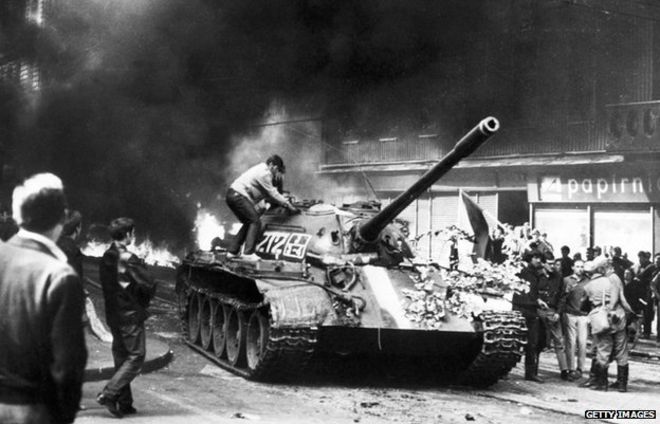
| Prague 1968 |
The reform movement was viewed by Leonid Brezhnev and other Soviet hard-liners in Moscow as a serious threat to the Soviet Union's hold on the Socialist satellite states, they decided to act. In the first hours on the 21st August 1968 Soviet planes began to land unexpectedly at Prague's Ruzyne airport, and shortly Soviet tanks would roll through Prague's narrow streets. Within hours foreign troops would take up strategic positions throughout the city, including surrounding the building of the Central Committee of the Communist Party, taking hold of Wenceslas Square, and eventually taking over Czechoslovak radio and television. Around 500,000 troops invaded and occupied Czechoslovakia in an operation code-named "Danube."
Some 500 Czechoslovaks were wounded and 108 killed in the invasion, which successfully ended political and economic reforms under the leadership of Alexander Dubcek and gave the Communist Party greater authority. The Soviet-led invasion helped establish the Brezhnev Doctrine, which Moscow said allowed the U.S.S.R. to intervene in any country where a Communist government was under threat. The Soviet backed occupation of Czechoslovakia would last until the velvet revolution brought an end to the Communist dictatorship in November 1991 as the Cold War ended.
Labels: Energy indepdendence, Green jobs
1968,
Alexander Dubcek,
Communist Dictatorship,
Czechoslavakia,
Dictatorship,
invasion,
Leonid Brezhnev,
Prague,
The Cold War,
The Prague Spring,
the Soviet Union,
Wenceslas Square
Monday, 20 May 2013
SOMEWHERE BETWEEN TRAGEDY AND FARCE
When it comes to the Afghan tragedy, a few quotes spring to mind, Karl Marx said "Hegel remarks somewhere that all great, world-historical facts and personages occur, as it were, twice. He has forgotten to add: the first time as tragedy, the second as farce." Winston Churchill said, "Those that fail to learn from history, are doomed to repeat it" and “Men occasionally stumble over the truth, but most of them pick themselves up and hurry off as if nothing ever happened.” When it comes to Afghanistan there is more than enough history to provide enough examples of what to do and what to avoid.
The long and bloody history of Afghanistan is littered literally with the would-be invaders who came to grief and eventually through in the towel and admitted defeat. This week, almost unnoticed an anniversary passed, Wednesday 15th May was the twenty-fifth anniversary of the start of the then Soviet Union’s nine month long withdrawal from Afghanistan. Around 100,000 Soviet troops had left the war torn country by February 15, 1989. This was the conclusion to ten years of brutal warfare which had killed over 14,000 Soviet soldiers and hundreds of thousands of Afghan combatants and civilians.
NATO forces have been on the ground in Afghanistan since the 7th October 2001, and preparations for NATO’s withdrawal (to be completed by 2014) are proceeding apace. Unlike their Soviet predecessors who treated much of Afghanistan as free fire zone, NATO forces have been relatively restrained when it comes to using their firepower. Despite this many people have argued that just like their Soviet predecessors NATO troops in Afghanistan now find themselves engaged in waging a campaign which is "unwinnable in military terms".
‘Lessons from Afghanistan’s History for the Current Transition and Beyond’ is a thought provoking paper produced by the MOD Development, Concepts and Doctrine Centre makes interesting reading. The paper has noted that between 1933 to 1973, Afghanistan was stable and reasonably effectively governed, however, that stability was firmly anchored in the two pillars of traditional local governance and the Afghan state such as it was a weak centralized though weak state, both of which were gravely damaged after 1978.
Afghanistan history’s is littered with a series of chronic succession problems and associated conflict, the next presidential election, if successful, would be the first peaceful transfer of leadership since 1933 and only the fourth since 1747. The paper also notes that any expectations about the pace of any progress and reform should be modest and the dangers of overly ambitious reforms leading to violent reactions need to be recognized.
‘A new approach to understanding Afghanistan’s transition’ has been produced by the United States Institute for Peace also makes interesting reading. This paper by way of comparison with other countries who have passed though conflict, significant military intervention and a post conflict period of transition looks at Afghanistan and its preparedness for life after NATO. Amongst the key issues that this report flags up is the issue of foreign aid and its impact on Afghanistan.
Of late there has been a relative flood of papers from a whole range of military and civilian institutes studying and analysing what has happen and what may happen in Afghanistan as NATO prepares to leave. While our soldiers and their families and many Afghans may carry the physical and mental scars for decades, the politicians (at least in the West) will probably do their best to air brush Afghanistan and the consequences of NATO’s intervention out of site and out of mind.
As someone who has had relatives who have served a number of tours in Afghanistan and have come back in one piece I will (no doubt along with more than a few other people) be more than grateful when the last NATO soldier hops on the last plane and comes home. Following NATO’S withdrawal I have little doubt that what will follow will be a public redefinition of ‘success’ at least as it is applied to Afghanistan. Quite where that leaves the Afghans and Afghan women's rights whatever future they face with a still active Taliban, rampant corruption and a curtailing of foreign aid remains to be seen, but nowhere good I suspect.
![]() |
| A scene from the Soviet withdrawal from Afghanistan |
![]() |
| Learning the lesson of history? |
‘Lessons from Afghanistan’s History for the Current Transition and Beyond’ is a thought provoking paper produced by the MOD Development, Concepts and Doctrine Centre makes interesting reading. The paper has noted that between 1933 to 1973, Afghanistan was stable and reasonably effectively governed, however, that stability was firmly anchored in the two pillars of traditional local governance and the Afghan state such as it was a weak centralized though weak state, both of which were gravely damaged after 1978.
Afghanistan history’s is littered with a series of chronic succession problems and associated conflict, the next presidential election, if successful, would be the first peaceful transfer of leadership since 1933 and only the fourth since 1747. The paper also notes that any expectations about the pace of any progress and reform should be modest and the dangers of overly ambitious reforms leading to violent reactions need to be recognized.
‘A new approach to understanding Afghanistan’s transition’ has been produced by the United States Institute for Peace also makes interesting reading. This paper by way of comparison with other countries who have passed though conflict, significant military intervention and a post conflict period of transition looks at Afghanistan and its preparedness for life after NATO. Amongst the key issues that this report flags up is the issue of foreign aid and its impact on Afghanistan.
![]() |
| Another military withdrawal from Afghanistan |
As someone who has had relatives who have served a number of tours in Afghanistan and have come back in one piece I will (no doubt along with more than a few other people) be more than grateful when the last NATO soldier hops on the last plane and comes home. Following NATO’S withdrawal I have little doubt that what will follow will be a public redefinition of ‘success’ at least as it is applied to Afghanistan. Quite where that leaves the Afghans and Afghan women's rights whatever future they face with a still active Taliban, rampant corruption and a curtailing of foreign aid remains to be seen, but nowhere good I suspect.
Labels: Energy indepdendence, Green jobs
Afghanistan,
Concepts and Doctrine Centre,
development,
Karl Marx,
NATO,
Redefining success,
the Soviet Union,
The Taliban,
United States Institute for Peace,
Winston Churchill,
Womens' Rights
Subscribe to:
Posts (Atom)


