Showing posts with label Spin. Show all posts

Thursday, 7 July 2016

THE REPORT INTO BLAIR’S WAR

To summarize the summary, the Chilcot Report (which covered the period from 2001 until 2009) has confirmed that the dossier prepared by Blair to make the case for war was deliberately distorted in order to convince Parliament to vote for an illegal war. The dossier did not reflect the evidence given to Blair by the security services. The report also confirms that Blair undermined the UN Security Council’s authority and that war was not a last resort.

It is now clear that when Blair was unable to secure a second UN resolution to legitimize the war, he pretty much handed over UK foreign policy to George Bush. Blair’s legacy is over a million dead, a failed state and a destabilized Middle East riven by conflict. The region as a whole in crisis, with people abandoning their homes and possessions and desperately fleeing their own brutal governments and equally brutal terrorist organisations, to seek sanctuary in Europe.

Basically the dossier that was used to justify the invasion of Iraq was based on a whole series of false statements (lies to the rest of us). Any judgements made about the severity of the threat posed by Iraq's weapons of mass destruction were unsound or unproven. Yet statements about WMD were written up as established fact – something which they were not. The Intelligence material used to justify the invasion had "not established beyond doubt" that Saddam Hussein had continued to produce chemical and biological weapons.

Additionally the Joint Intelligence Committee said Iraq has "continued to produce chemical and biological agents" and there had been "recent production". It never stated that Iraq had the means to deliver chemical and biological weapons and it did not say that Iraq had continued to produce weapons. And Blair’s policy on the Iraq invasion was made on the basis of flawed intelligence assessments – this was not challenged, and it should have been robustly challenged – but wasn’t.
Blair staked everything on the case for war – unfortunately for him (and the Blairites) - the circumstances in which it was decided that there was a legal basis for UK military action were "far from satisfactory". The invasion began on 20th March 2003 but it was not the 13th March that the then Attorney General Lord Goldsmith advise that there was, on balance, a secure legal basis for military action. It is worth noting that aside from No 10's response to his letter on 14th March, no formal record was made of that decision and the precise grounds on which it was made remain unclear.
The UK's actions directly undermined the authority of the United Nations Security Council, as the UN's Charter places responsibility for the maintenance of peace and security on the Security Council. The UK government made much of its false claim that it was acting on behalf of the international community "to uphold the authority of the Security Council". Yet it knew it did not have a majority supporting its actions. In Blair’s Cabinet, there was little questioning of Lord Goldsmith about his advice and no substantive discussion of the legal issues was recorded.
If the case for war was flaky, so was the preparation for war on the part of the MoD. Chilcot noted that the military had "little time" to properly prepare three military brigades for deployment in Iraq. For years soldiers who have served in the army in recent and not so recent years have repeatedly told me (`nd others) that they routinely bought their own kit.
The risks were neither "properly identified nor fully exposed" to ministers, resulting in "equipment shortfalls". Between 2003 and 2009, our soldiers in Iraq faced gaps in some key capability areas - including armoured vehicles, reconnaissance and intelligence assets and helicopter support.
Chilcot has noted that it was not sufficiently clear which person in the department within the Ministry of Defence had responsibility for identifying and articulating such gaps. Delays in providing adequate medium weight protected patrol vehicles (something that resulted in the deaths of our soldiers) and the failure to meet the needs of UK forces for reconnaissance and intelligence equipment and helicopters should not have been tolerated.
Despite repeated and explicit warnings, the consequences of the invasion were significantly underestimated. The planning and preparations for Iraq after Saddam Hussein were "wholly inadequate" – basically there was no coherent plan for the aftermath of the invasion. The UK government pretty much failed to achieve its stated objectives it had set itself in Iraq – and then in my opinion tried to spin its way clear of the consequences.
More than 200 British soldiers died as a result of the conflict. The Iraqi people also suffered greatly, by July 2009, at least 150,000 Iraqis had died, and more than one million were displaced. By 2016 this figure had grown to 1.2 million and the consequences of the invasion and destruction of the Iraqi dictatorship had destabilised the region and fed the war in neighbouring Syria.
The decision to go to war understandably should be the most difficult decision that any political leader ever has to make. To justify that decision, with falsehood and deceit for simple political expediency, is and will always be unforgiveable. Current and former political leaders who directly lied to the public to make the case for a war, which put our soldiers (without the necessary kit they needed and with ill-defined objectives) into harms way, should justly face lasting consequences for their actions.

Thursday, 13 August 2015

DUPLICITY AND DELAY

The beginning of a beautiful friendship
The delays in the publication of the Chilcot Report are a telling indictment of the duplicity of those involved in making the decision to spin a web of lies to make the case for war in 2003. The inquiry was somewhat reluctantly set up by the then New Labour Government in 2009 - the hearings were completed in 2011. 

Disputes over the publication of evidence and the right of advanced rebuttal by those included in the report then followed, including arguments over whether or not memos between the then Prime Minister Tony Blair and US President George Bush could be published or not also followed. 

No matter how much spin was spun to add weight to the reasons for the invasion, the toppling of Saddam Hussein, the costly occupation of Iraq, etc - it is impossible to get away from the idea that the then New Labour Prime Minister simply lied to the House of Commons and the rest of us. The whole wretched process is yet another very public demonstration of the abject failure of the Westminster institution to call them to account and the lengths to which the so called elite will go to to protect their tarnished reputations. 

Friday, 17 April 2015

MORE SMOKE AND MIRRORS

Despite the promises of more money for Wales if Labour in Westminster actually implement the Mansion Tax, the Institute for Fiscal Studies has forecast that Labour’s plans will in fact lead to real term cuts. Perhaps it’s time for Labour to come clean and admit that they plan to cut the Welsh Budget.

Plaid Cymru has rightly warned voters not to be deceived by the Labour party’s spin. For while Labour has been talking about raising money through a mansion tax, they have already signed up to plans that will cut more than a billion pounds from Wales’ economy.

Labour has already confirmed that previously that it will stick to the Con Dem  plan to cut departmental spending by over £1.5bn across the UK. This lower base for expenditure means that Wales will lose an additional £365 million over the next five years compared with 2014-15.

The IFS has estimated (March 2015) that starting this year (2015) Wales and the other devolved administrations will end up losing 2.2 per cent of their funding in real terms by the end of the next parliament leading to a cumulative, real terms loss for Wales of £835 million. Taken together Labour will cut funding to Wales by £1.2bn (£365m plus £835m) in real terms over the coming five years.

Despite Labour’s belated acknowledgement that Wales is underfunded, Labour still intend to make yet deeper cuts into the Welsh budget. Once again Labour are trying to pull the wool over our eyes by claiming that they will put more money into Wales’ economy while signing off spending plans that will cut more than £1 billion from Wales. This is a classic case of giving with one hand and taking away with the other.


Plaid Cymru is the only party in Wales making the case to stop austerity and to grow our economy. We also want Wales to be funded to the same level as Scotland. Plaid Cymru’s economic plans are focused on growing Wales’ economy. We need to invest to create jobs, increase our tax intake and bring down the deficit. We need to close the gap between the rich and the poor and we are the only party focused on rebalancing power and wealth throughout the UK.

Thursday, 11 December 2014

WHAT’S THE PRICE A FREE PRESS?

Whether you live in the old West, the old East for the Middle and Far East, the problem of press freedom and the need of an independent free press is universal. The continued consolidation of media outlets, for whatever reason – economic or political – means that there are fewer and fewer independent media outlets. Most people still take their news from the larger, often state or media mogul run, news outlets rather than ‘independent news sources.’ Providing you are aware of the element of ‘spin’ this should not be problem. Yet recent evidence in relation to the scale and weight of spin and the narrowness of news outlets reportage has been provided by the questionable coverage of the Scottish referendum and subsequent political developments. If your message is not popular with the media moguls or the state run (or controlled) media outlets then despite the presence of the internet and social media getting your message out or providing independent scrutiny of governmental decisions is increasingly difficult. What’s going on in Tomsk, in Siberia is typical of what is going on around the world.


----------------------------------------------------------------------------------------------

Independent Siberian TV Channel Faces Shutdown

By Robert Coalson
December 09, 2014
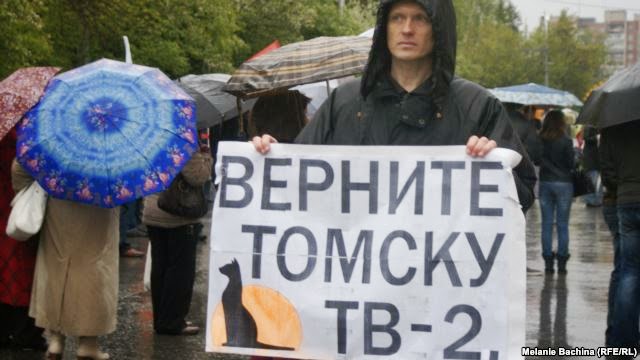
A protester expresses his support for Tomsk TV-2 
When the clock strikes midnight on New Year's Eve this year, audiences in the Siberian city of Tomsk will likely lose a familiar, independent source of information.
Tomsk TV-2, which is widely seen as one of the most respected and professional regional television stations in Russia for the last 23 years, has been informed by the city's state-monopoly television broadcast center that it will cease transmitting the channel's signal as of January 1.
Although the reasons behind the threatened shutoff remain murky, it comes against a background of state pressure against activists, nongovernmental organizations, and nonstate media in Russia by both national and local authorities.
The announcement by the Tomsk Regional Broadcasting Center violates the terms of the contract with TV-2 itself, as well as Russian antimonopoly legislation, says the station's lawyer, Anastasia Olgovskaya.
The station has said it will appeal the decision. But Melani Bachina, a Tomsk TV-2 presenter and producer who is also a freelance correspondent for RFE/RL's Russian Service, says she suspects this may come to nothing.
"No one is trying to be in contact with us," she says. "No one is making any effort to talk to us about anything. No one has given us any argumentation for why this is happening." The lack of any effort to resolve the issue makes her feel the decision to close down TV-2 "has already been made."
Nowhere To Appeal
TV-2 representatives do not know what the reason for the transmission center's decision is, but they are convinced the impetus for the impending closure came from someone else.
"It is perfectly clear that the transmitters are only the middlemen in this, that someone else stands behind this decision," Bachina says. "But who is it? Of course, we have suppositions, but since we have no facts or evidence, there is nothing that we can do and we cannot appeal to those people or to that person."
TV-2 editor Viktor Muchnik agrees. "Our story, like so many stories in our country, is unfortunate in that the person acting against us is anonymous," he says. "We are always dealing with some sort of intermediary who says: 'I don't know anything. They tell me from above what to do and I do it.' We can only guess who is pulling the strings. But I know that the mere existence of this channel over the years has been a problem for many people."
Earlier this year, the transmitter stopped broadcasting TV-2's signal for about six weeks, claiming that some TV-2 equipment had damaged equipment belonging to the transmission tower. That blackout prompted the Russian Justice Ministry's national media register to warn TV-2 that it would lose its license if it did not resume broadcasting. Although the dispute was resolved, activists saw it as a warning to the channel.
Bachina says she has no idea what will become of the station's 300 employees, adding that there is little chance TV-2 could switch to cable or Internet broadcasting.
"The majority of our audience is elderly. They are people who have been watching TV-2 for years," she says. "These are people who, in one way or another, become the subjects of our reports. These are people who do not even have cable TV -- they receive us through terrestrial broadcasting. So, what is the point in talking about switching to the Internet? These people will be deprived of this source of information."
Last Independent Voices
The impending shutdown of Tomsk TV-2 comes against the background of a similar assault by the authorities on the popular independent television channel Dozhd TV. That channel was removed from cable and satellite networks in February and has been forced to ask viewers for payments.
Dozhd has been evicted from its Moscow offices twice in recent months and, according to the BBC on December 8, is currently broadcasting from an employee's residence.
The liberal national radio station Ekho Moskvy was involved in a dispute last month between its journalists and its owner, Gazprom-Media, in which the latter briefly threatened to fire the station's chief editor and revamp its news and talk format.
TV-2 editor Muchnik says independent regional channels are far more vulnerable to the whims of local officials.
"Of course, this is a very bad precedent," Muchnik says. "It is particularly bad because the economic situation in the country is getting worse, tensions are increasing, especially in the regions. Of course, any local official is going to be at odds with any local media that doesn't relate the news according to his script. And this conflict is going to be twice as bad or three times as bad under these growing tensions."
"If this can happen to us, then it can happen anywhere -- in Kuban, in Krasnoyarsk, in Yekaterinburg -- anywhere," he adds.
Written by Robert Coalson on the basis of reporting by RFE/RL's Russian Service and Current TV