Monday, 20 January 2014

DID HE REALLY SAY THAT?

When someone you have convinced yourself is your best friend (and you believe has your best interests at heart) says something truthful but hurtful about you that can be upsetting. However, when they say it publically for all to hear then it’s twice as hurtful and if you had any sense you might be well advised to question the value of your so called friendship. The former US defence secretary, Robert Gates has said that cuts to the UK's armed forces will limit the country's ability to be a major player on the world stage. And that the spending cuts would mean the UK could no longer be a full [useful] military partner of the US.

Under the current Con Dem Coalition government’s plans, by 2020 the Army will have lost some 20,000 personnel, with the Royal Navy losing 6,000 and the RAF some 5,000. Despite the cuts the MOD was quick to point out that the UK still has the fourth largest defence budget in the world. However, when interviewed by BBC Radio 4's Today programme (16.01.2014) Robert Gates noted that - for the first time since World War One - Britain did not have an operational aircraft carrier.

Mr Gates, who served under presidents Obama and Bush, singled out cuts to the navy as particularly damaging. He said; "With the fairly substantial reductions in defence spending in Great Britain, what we're finding is that it won't have full spectrum capabilities and the ability to be a full partner as they have been in the past." Incidentally, last month the Chief of the Defence Staff, General Sir Nicholas Houghton, warned that the UK could be left with the "spectre" of a hollowed-out force. While this latest American  intervention probably won’t reverse Cameron’s defence cuts it will wound the UK's pride and may shatter a few still held illusions or possibly delusions.

The not so big secret to the UK’s so called ‘special relationship’ with the USA dates back to the dark days of the Second World War is that the relationship is not that special. The UK was dependent on aid from the USA well before Pearl Harbour brought the Americans into the war. Our history (or more like our spun history) tells us that ‘lend lease’ saved us, what’s not said is that ‘lend lease’ was more like ‘cash and carry’ i.e. they take our cash and we do the carrying across the broad U Boat filled Atlantic even after America came into the war.

By the war’s end Britain was pretty much broke (or at least financially challenged) and stretched pretty thin militarily (in terms of manpower UK and Commonwealth forces peaked out in the autumn of 1944|). The Empire and with it ‘imperial responsibility’ unravelled surprisingly rapidly in the post war years. Britain walked from Palestine and Greece, and India, Pakistan, Burma and Sri Lanka gained their independence, despite this the delusionary myth of Imperial greatness and the ‘special relationship with the USA remained.

The reality was that the USA since the early part of the twentieth century had been one way or another pretty much determined to break up the British Empire. Any delusions that the ‘Brits’ had about their position in the world, should have evaporated during and after the Suez crisis when an irate President Eisenhower, told Britain’s Prime Minister Anthony Eden bluntly to halt the military invasion of Egypt or face up to the economic and political consequences. Britain and France found themselves up against it in the face of US economic and political power and interests in 1956 and both lost.

The French decided to maintain an independent foreign policy, which if it coincided with US interests was all well and good, but if not then no matter. The Brits made a different choice, they decided never to oppose US interests again, at least not publically, from 1956 onwards US interests would be British interests requardless. Under continual pressure from the US the remainder of the Empire vanished far more rapidly than it was acquired, being mostly gone by 1964.

The Brits pretty much never stepped out of line again, unlike the French, who retained control of their own foreign policy. Now all this may be slightly delayed fallout from the so called Westminster elite’s failure to secure a majority in the House of Commons for military action over Syria. With the ‘Brits’ making the awkward transition from useful ally and friend  to potential liability people may well be forgiven for wondering where does that leave the so called ‘special relationship’?  

Thursday, 16 January 2014

A BETTER CHOICE FOR COMMEMORATION...

Perhaps rather than Field Marshal Kitchener a better choice for a commemorative coin would have been the nurse Edith Cavell, who was working as a nurse working in Brussels when the city was occupied by the forces of Imperial Germany in 1914. She remained in Brussels treating the wounded and helping the sick and worked with others to help more than 200 allied soldiers to escape from occupied Belgium.

Edith Cavell
She was arrested and sentenced by an Imperial German military court to death (with 33 others) and shot by a firing squad on October 15th 1915. This act, despite international appeals for clemency (including from neutral powers), along with other brutal atrocities committed by Imperial German forces in Belgium did much to sway world opinion to the Allied side.

While a very recognisable public figure, Kitchener, had in the eyes of some, blotted his copy book after the battle of Omdurman by looting the tomb of the Mahdi (Muhammad Ahmad bin Abd Allah) and removing his skull for a desk ornament (until persuaded by others to return it). Not exactly astute behaviour for a powerful figure in an Empire had a significant number of Muslim subjects living within it. 

He gets the blame in some circles for inventing concentration camps which were used to detain much of the Afrikaner and Black civilian population in the brutal guerrilla war stages of the second Boer war. Neglect, incompetence, indifference, mismanagement and poor sanitation rather than any planned catastrophe resulted in significant numbers of deaths amongst the interned white and black population. While often accused of inventing concentration camps, the reality is that while Kitchener made use of then, their inventors may have been the Dutch (in the then Dutch East indies) and the Americans In the Philippines) in their respective brutal colonial wars. 

An iconic image?
By 1914, Kitchener, depending on which sources you look at was in the eyes of the Westminster elite, on his way out. When war broke out, he was on leave and was drafted into the cabinet, as Secretary of War (he drew no parliamentary salary) by Asquith. He was out of his depth and ever loyal to Asquith he became easy prey for the politically astute and ambitious Lloyd George.

Kitchener clashed with Lloyd George over the raising of a Welsh division and over the initial refusal of the army to provide non conformist chaplains (to minster to Welsh soldiers spiritual needs) – he eventually lost on both counts. After Gallipoli, his days in office were increasingly difficult (and probably numbered) until he was drowned on his way to Russia when HMS Hampshire was sunk in June 1916.


Edith Cavell’s, last words were: "I realise that patriotism is not enough, I must have no hatred or bitterness towards anyone".  She did not want to be remembered as a martyr or a heroine but simply as "a nurse who tried to do her duty". In the year in which we start to commemorate the First World War, the likes of Edith Cavell should perhaps be honoured by a commemorative coin, rather than Kitchener.

Saturday, 11 January 2014

ABERTILLERY RAILWAY STATION

The town of Abertillery in Blaenau Gwent (has a population of about 18,000) and high unemployment. As a former mining town, since the 80's,has suffered a significant increase in benefit receipt, a significant decline in amenities and relatively low economic and employment opportunities. In Scotland simular former mining towns have benefited economically and socially from having old railway lines to Glasgow opened. The re-opening of the Ebbw Vale line to Cardiff (and hopefully eventually to Newport) has brought opportunities to the Ebbw Valley.

Sign the petition to open a train station at Abertillery.

A direct rail link and a railway station in Abertillery would give people access to job opportunities in Cardiff and on the coastal belt. The restored rail link would also bring tourism to a beautiful and historic part of our country. At present the floored devolution settlement means that the Department for Transport makes the final decision on re-opening old railways and building new stations, even if the National Assembly wants it done.

Thursday, 9 January 2014

GOING DUTCH?

As has been noted elsewhere there can be no blank cheque for flood defences; we need to make rational and cost effective sustainable choices when it comes to coastal defence. We need to decide how we are going to deal with the weather related effects of a warming world with expanding and rising oceans. Now I am not suggesting for a moment the wholesale abandoning of large tracts of our country to the ravages of the ocean. Rather we need to make rational long term sustainable choices about flood defence and the development of a comprehensive planning system for our country. 

After the flooding...
We need to build in flood prevention / flood avoidance as part of the planning system and make efforts to avoid building in those areas that are vulnerable to flooding or at least build to take into account the possibilities of flooding. If we are going to build on flood plains or other areas that are vulnerable to flooding then we must use flood resistant or at least flood hardened modern intelligent design techniques to limit potential future damage, loss and inconvenience as is done elsewhere. 

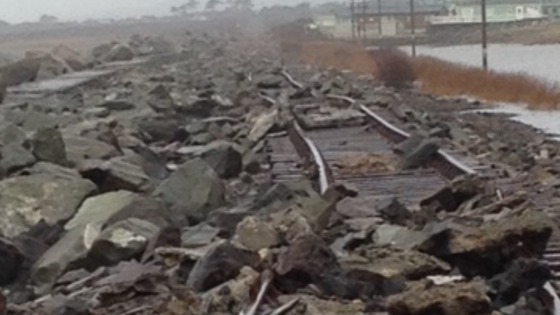
Our country has around 5,000 miles of coastline, not all of which is inhabited or at prime risk, but even so, going Dutch with wholesale widespread sea defences would be an expensive option for Wales, let alone the UK. Now those coastal roads and railways that have been damaged by the recent combination of bad weather and high tides will be repaired in the short term.

We in Wales do need to take a longer view and seriously consider the possibilities of relaying railway lines and building roads away from those more vulnerable coastal areas. Additionally we need to harden our power network and our communities to the effect of severe weather events. That said we are in a much better position to make more rational coastal defence choices than some countries in the developing world and to seriously consider just exactly where we put key infrastructure.

The quick fix (and short term gain) may be one of our biggest problems here in Wales along with the lack of sensible detailed all Wales development planning. Across the border, Westminster’s institutionalised short term view led to the cutting of £500 million pounds from the Environment Agency budget (between 2010 and 2013, and anticipated another ‘saving £ 300 million pounds by 2015 and the cutting of some 1,500 jobs. I suspect that in the wake of the last few weeks the Con Dems may revisit this...


The Pacific island nations and Bangladesh will face the potentially catastrophic social, economic and political consequences of rising and expanding oceans before we will.  Even the Dutch have after over 500 years of experience trying come to the conclusion that in some cases it is better to build in flood room, setting aside some coastal wetlands and other land as places that will be allowed to flood to take the pressure of other areas. 

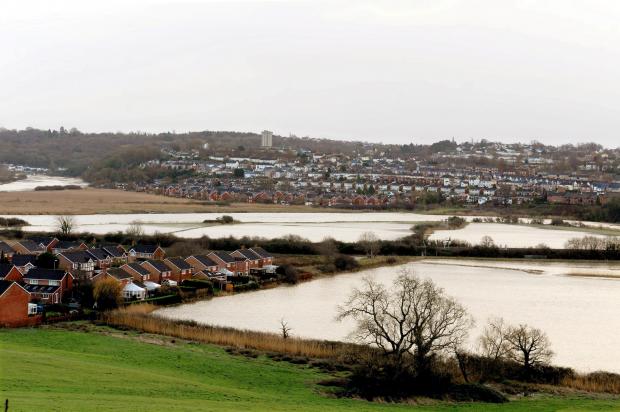
A close call near Caerleon, near Newport in the lower Usk Valley
Some parts of our country got hit hard by the recent coastal flooding and bad weather, other areas literally dodged the bullet , we may not be so lucky next time. Westminster budget cuts mean (unless they are reversed) that in England there will be less money, less resources and less people to work to prevent future floods. We in Wales cannot afford that short of dull short term thinking... we need to start the process of better flood prevention now before the next time.

Monday, 6 January 2014

MISSING IN INACTION

Once again the Labour Party has failed to stand up to protect our country’s natural resources from exploitation by Westminster. Labour Party MP’s put party interest before our national interests by abstaining on a key vote to devolve full control over Welsh water to the National Assembly – even though their own Government in Cardiff wants this to happen. The vote on Plaid Cymru's amendment followed a Commons debate on the final stages of the Water Bill - every single Labour MP from Wales was absent. Ironically the Labour in Wales Government in evidence to the Silk Commission noted that it wants to see the National Assembly gain full control over all matters relating to Welsh water. So much for joined up thinking and so much for standing up for Wales! 

Hywel Williams MP speaking after the debate said:

"This is an embarrassing episode for the First Minister and his Labour Welsh Government who, once again, have been let down by Labour MPs from Wales.

"Just as in the case of devolving energy projects up to 100 MW and devolving Air Passenger Duty to Wales, the First Minister says one thing in Cardiff while his London colleagues seem intent on undermining his every word.

"Water has been an emotive, emblematic and defining political matter in Wales. It is just one aspect of our nation's wealth of natural resources but our people are unable to benefit from its use due to the UK Government holding the power of veto over all matters relating to Welsh water.

"Had Plaid Cymru's amendment been carried, we would have seen control over Welsh water transferred from Westminster to the National Assembly, ensuring that any wealth generated from its extraction and export would benefit our nation.

"It is disappointing to see the Labour party in Wales yet again conform to the cosy Westminster consensus rather than put the interests of the Welsh economy and people first."

Saturday, 4 January 2014

HONOURS EVEN…

The Donations Award
The questionable relationship between big donations (and donors) to political parties might in some circumstances be considered to be par for the course (to use a golfing term). Significant donors to the larger Westminster village based (and focused) political parties often tend to get rewarded with gongs, baubles and trinkets. Between 2006 to 2012 those donors giving £50,000 or more to Westminster based political parties were around 6,000 times more likely to receive a peerage than the ordinary person on the street. It has been 80 years since Maundy Gregory became the first (and only) individual to be prosecuted for selling honours and the relationship between cash (and kind) donations and honours remains as strong as ever. The House of Lords Appointments Commission which (nominally) oversees the award of honours is in truth pretty powerless and mostly accepts party leaders’ choices in all but the most exceptional of circumstances. Selling honours is illegal yet more than a few years ago a parliamentary committee came to the conclusion that any successful prosecution would be unlikely unless the culprits were caught in the act so to speak, so the law remains unchanged, so basically the Westminster based political parties have a free-for-all. The honours system as long as it remains under the control of Westminster will remain flawed and abused with little prospect of any meaningful reform. What this on-going abuse of the honors system by the Westminster based political parties means in practice is that the award of honors to hardworking individuals who have worked tirelessly for our communities, to society and to the lives of others over the years is continually tarnished and the value of honours is diminished.  

Thursday, 2 January 2014

MORE OF THE SAME...

Samuel Johnson said amongst other things that the prospect of being hanged focuses the mind wonderfully… perhaps the prospect of being hung out to dry (financially) by the big six energy companies, the supermarkets, and Severn Crossings PLC no longer registers as anything more than simple irritation. Perhaps we can become so accustomed to being fleeced that the grimly anticipated rise in Severn Bridge tolls (which kicked in on January 1st 2014) no longer registers. The cost of crossing into Wales by car has increased to £6.40 - a rise of 20p - while small goods vehicles must now pay £12.80 (a 40p increase) and HGVs £19.20 (a 60p increase). The Severn Bridge operators roll out the same old tired excuses for their greed saying that the tolls were agreed by a parliamentary order and in line with the Retail Price Index (RPI).

Not quite a subsidised toll bridge near us...
Yet when it comes to the Severn Bridge tolls, the often ignored literal elephant in the room is the subsidy that is applied to the Humber Bridge. When last in office at Westminster, Labour chose to quietly and regularly subsidise the Humber Bridge tolls, yet, it made no move what so ever towards doing anything about dealing with the tax on jobs, businesses and commuters which are passed off as the Severn bridge tolls. This may explain to some degree what our local Labour MP’s do little beyond trotting out the same old tired press releases bemoaning the failure of the Government to do anything. Interestingly enough the Humber Bridge subsidy has been continued by the Con Dem Coalition Government, a government that has driven the post Thatcherite ‘free market’ ideology into wholly new areas, yet has shown no inclination to curb the Humber Bridge state subsidy or offer to help Welsh commuters and businesses out with a simular subsidy.

At some point in 2018 ownership of the two Severn Bridges will revert back to the Westminster Government ‘s Department for Transport, but only takings from the tolls reach £ 996 million pounds (at 1989 prices). The Labour in Wales Welsh government has said that it would like to take control of the tolls in future when the Severn Crossings return to public ownership and that it would look to reduce them although it believes abolishing them would leave too great a hole in the budget. A recent consultants' report revealed that the abolition of bridge tolls could boost the economic output in Wales by £ 107 Million pounds. By the time the two Severn Bridges come back into public ownership in 2018, it has been estimated that this cash cow may have been milked to the tune of about £ 1.029 billion pounds.

Oddly enough to add regular insult to regular injury the old (M48) Severn Bridge continues to be periodical closed at weekends for routine maintenance, which are funded by the Department for Transport, from the public purse. Plaid has called for the transfer of powers (to Wales) so that the tolls on the bridges can be reduced, something that could have a considerable impact on businesses and the economy. With control over the bridges devolved, Plaid would cut the tolls to £2 to cover maintenance costs. The costs for upkeep are £15 million per year, but motorists and vehicles using the crossings currently generate £72 million pounds per year. While the tolls would form a useful revenue stream for Welsh Governments, the priority of Plaid is to cut the tolls.

Back in October 2010, Professor Peter Midmore's independent economic study of the Severn Bridge tolls recommended that the revenues from the tolls should stay in Wales, once the crossings revert to public hands. The study of 122 businesses commissioned by the Federation of Small Businesses revealed that the tolls had a negative impact on 30% of firms in South Wales, this compared with 18% in the Greater Bristol area. It noted that the economic impact was not substantial for most, the 2010 study found that transport; construction and tourism-related companies reliant on regular crossings suffered increased costs and reduced competitiveness. The 2010 study found that Welsh businesses were unfairly penalised by the tolls and concluded that the money should be shared with the Assembly Government and used to improve Wales’ roads and public transport.