Showing posts with label Oxfam. Show all posts
Showing posts with label Oxfam. Show all posts
Sunday, 9 September 2012
OUR DAILY BREAD?
As fuel prices creep upwards, as we are waiting to get hit by price rises from the energy cartel, the next hard blow to our wallets will come in the form of rising food prices. The poor summer across the northern hemisphere (either too wet or too dry) is impacting on global food prices which have risen by 10% in the month of July, which has raised the fears of soaring prices for the planet's poorest, as noted by the World Bank.
Oxfam has noted that when extreme weather events drive local or regional price spikes, the people living in poverty face a double shock as they have to cope with higher prices, just like the rest of us. The difference between the developed and developing world is that this often comes at a time when the direct effects of extreme weather events have often already depleted their assets, destroyed their crops and stripped them of their livelihoods.
Back in 2011 the emergency in the Horn of Africa and the 2012 Sahel food crisis clearly showed how this combination can lead to hunger on a mass scale. The small-scale subsistence farmers and the pastoralists ended up getting hit hard in both regions, where the loss of livestock and crops reduced available food stocks and also reduced the value of people’s assets so that they were unable to afford to buy food
The World Bank has warned that the affects of the US heat wave and drought in parts of Eastern Europe were partly to blame for the rising food costs. Key grains such as corn, wheat and soybean saw the most dramatic price increases, something that will hit those countries that import grains particularly badly. Between June to July (2012), corn and wheat prices rose by 25% and soybean prices increased by 17%. The World Bank noted that only rice prices fell by some 4%.
In the USA, the worst (and widespread) drought for fifty years has wrought havoc on the corn and soybean crops while simultaneously in Russia, Ukraine and Kazakhstan, the wheat crops have been badly damaged. To make matters worse, the World Bank noted that the continued use of corn to produce ethanol biofuels (which absorbs around 40% of US corn production) played a key role in the sharp rise in the price of US maize.
While we (the food consumers) will all loses out, the impact on developing countries in North and Sub-Saharan Africa and the Middle East who will be the most exposed to price rises because significant quantities of their food is imported and food bills make up a large proportion of average household spending, will be harsher. .
Already maize prices had increased by 113% over the past quarter in Mozambique, and the price of sorghum had risen 220% in South Sudan. Last time this happened (back in 2008) there was widespread unrest. Other potential factors could make a potentially bad situation worse and force grain prices still higher. The World Bank is concerned about a combination of food exporters pursuing panic policies, a severe El Nino, poor Southern hemisphere harvests and strong increases in energy prices.
The World Bank's Food Price Index (which tracks the price of internationally traded food commodities) was six percent higher than in July 2011 and one percent up from the previous peak, which was back in February 2011. Why is this important? Well aside from the fact that the most vulnerable in poorer countries will lose out? While we won’t starve, in the developed world as food (and fuel) prices go up, our purchasing power goes down (and we spend less), something that will hit the wider economy.


Friday, 4 November 2011
SHIPPING EMISSIONS
The Committee on Climate Change (CCC) has recommended that greenhouse gas emissions from shipping should be included in the UK's climate change budgets. The Climate Change Act has committed the UK to cutting all its climate-changing emissions by 80% - based on 1990 levels - by 2050. At the moment, however, international aviation and shipping emissions are not currently included. If the Con Dem Government agrees that this will mean tighter targets for other sectors such as motoring and electricity generation.
The CCC has suggested that shipping might account for up to 10% of emissions allowed under the 2050 target. This is something that needs to be tackled on a global basis, and if coherent co-ordinated international action proves impossible, it is quite likely that the European Union will introduce measures for traffic in and out of European ports.
The World Wildlife Fund and Oxfam issued a report which recommended some kind of global shipping tax which could be used to raise some of the $100 billion dollars per year of climate-related cash that rich countries are committed to providing to the developing world by 2020. The problem of shipping emissions Global Forum on Transport and Environment in a Globalising World (which met back in November 2008 in Guadalajara, Mexico) produced a report on the Environmental Impacts of Increased International Maritime Shipping which looked at the implications for maritime diesel emissions.
The report noted that shipping activity has increased significantly over the last century, and represents a noticeable contribution to global emissions of pollutants and greenhouse gases. The report concluded that projections up to year 2020 indicate a growth in fuel consumption and emission in the range of 30%. It also suggested that most scenarios for the near future, the next 10-20 years, suggest that regulations and measures will be outweighed by an increase in traffic leading to a significant global increase in emissions from shipping.
One simple solution is to base manufacturing industry more locally rather than ship finished products across the globe. This is something that would benefit Welsh communities, save money, especially when you consider the rising costs of maritime diesel and reduce the carbon footprint of manufactured goods and cut pollutants which affect all of us.
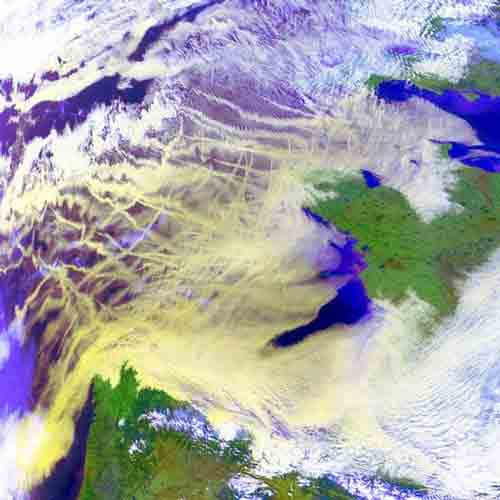 |
| Shipping emissions in the Bay of Biscay |
The World Wildlife Fund and Oxfam issued a report which recommended some kind of global shipping tax which could be used to raise some of the $100 billion dollars per year of climate-related cash that rich countries are committed to providing to the developing world by 2020. The problem of shipping emissions Global Forum on Transport and Environment in a Globalising World (which met back in November 2008 in Guadalajara, Mexico) produced a report on the Environmental Impacts of Increased International Maritime Shipping which looked at the implications for maritime diesel emissions.
The report noted that shipping activity has increased significantly over the last century, and represents a noticeable contribution to global emissions of pollutants and greenhouse gases. The report concluded that projections up to year 2020 indicate a growth in fuel consumption and emission in the range of 30%. It also suggested that most scenarios for the near future, the next 10-20 years, suggest that regulations and measures will be outweighed by an increase in traffic leading to a significant global increase in emissions from shipping.
One simple solution is to base manufacturing industry more locally rather than ship finished products across the globe. This is something that would benefit Welsh communities, save money, especially when you consider the rising costs of maritime diesel and reduce the carbon footprint of manufactured goods and cut pollutants which affect all of us.
Wednesday, 12 October 2011
LAND AND POWER
As multi nationals and the People's Republic of China (PRC) continue to chase to attempt to secure control of the worlds resources one thing they are both seeking to secure control of (for different reasons) is food and the land it grows upon. With purchasable governments in certain quarters of the world it's the small farmer who's felling the pinch, losing both his land, the ability to feed his family not to mention the ability to feed other people. Planet-wide it has been estimated that there are some 500 million small farms (less than two hectares in size) which feed around one third of the planets population.
Half of the planet's undernourished citizens are dependent on small farms for their food. Some 80% of food consumed in Asia and sub-Saharan Africa is produced by small farms. As our planet's population continues to increase (it's estimated to reach around 9.2 billion people by 2050) there will be a corresponding rise of around 70% in demand for food (UN). So with the PRC chasing food as well as minerals to feed it's population and it's economy and the multi nationals chasing a fast buck no doubt at the expense of local indigenous inhabitants who won't be able or willing to pay top dollar or euro for foodstuffs that are destined for distant foreign markets.
Local people will be driven into dire poverty, they lose their land in the process along with the ability to feed themselves and other peoples. Oxfam's recent report 'Land and Power' makes interesting and alarming reading. One of the great ironies is that many of the developers are working with local governments who are being helped out by the world Bank and the International Monetary Fund - this surely is the kind of alleged 'free market' development much of Asia and sub-Saharan Africa can well do without.
Half of the planet's undernourished citizens are dependent on small farms for their food. Some 80% of food consumed in Asia and sub-Saharan Africa is produced by small farms. As our planet's population continues to increase (it's estimated to reach around 9.2 billion people by 2050) there will be a corresponding rise of around 70% in demand for food (UN). So with the PRC chasing food as well as minerals to feed it's population and it's economy and the multi nationals chasing a fast buck no doubt at the expense of local indigenous inhabitants who won't be able or willing to pay top dollar or euro for foodstuffs that are destined for distant foreign markets.
Local people will be driven into dire poverty, they lose their land in the process along with the ability to feed themselves and other peoples. Oxfam's recent report 'Land and Power' makes interesting and alarming reading. One of the great ironies is that many of the developers are working with local governments who are being helped out by the world Bank and the International Monetary Fund - this surely is the kind of alleged 'free market' development much of Asia and sub-Saharan Africa can well do without.
Friday, 24 June 2011
FOOD FOR THOUGHT?
Oxfam Cymru claim half of Welsh people have changed their eating habits in the last two years, with 39% having to do so because food prices have rocketed.They suggest that more people in financial distress are approaching food banks for free, short-term supplies (as previously blogged by Leanne Wood AM). The OXFAM survey, which is part of a global study into eating habits in the last two years, comes after the Office for National Statistics revealed rising food inflation was escalating the cost of living.
The hard statistics reveal that a range of foods have undergone sharp rises, with prices of meat up 5.1%, fish up 11.4%, bread and cereals up 5.8%, mineral waters, juices and soft drinks up by 10.3% and jams by 7.5%. Oxfam Cymru says only 60% of Welsh respondents reported having enough to eat on a daily basis – with 39% saying they got enough, most or some of the time. They pointed to global figures, which showed an average 61% getting enough to eat all the time, indicating the Welsh statistics were part of a global problem.
A number of issues are going to impact on food prices, here and in the rest of the world. There is Climate Change, which as temperatures rise, will lead to a fall in crop yields – potentially we are talking of up-to half of their current levels in some African countries. At the same time, extreme weather events like heat waves, droughts and floods will get worse and become more frequent, and the seasons that people rely on to grow crops will get even more unpredictable.
Across the world governments have dragged their feet for too long. We need to start dealing with a situation that's only going to get more urgent. The food price spikes of 2008 are partially related to and being aggravated by land grabs, as wealthy companies have invested heavily in cheap agricultural land in poor countries, often for commercial use. The land that is sold is actually being used by poor families to grow food in many cases.
Poor farmers and their families are often forcibly evicted with little or no warning or compensation, and to make things worse often the land is either left idle by investors who know it will only grow in value, or actually used in ways that reduce food production. So it's time for effective global rules to get land grabs under control – rules which ensure local communities see the benefits of investments and which help make sure that governments provide secure access to land for smallholder farmers, and especially women.
After decades of progress, the number of people without enough to eat is actually increasing, and food price spikes are a big part of the problem. That's because, when you spend up to 75% of your weekly income on food – as many poor families are forced to do – sudden rises have an especially destructive effect. Price spikes have many causes including the changing climate, oil prices, dysfunctional commodities markets, biofuels policies that turn potentially productive crop-lands into fuel for cars rather than fuel for people. Oxfam and a number of other agencies conclusions is that we are facing a whole new challenge.
It's time for governments to actually work together to deal with food price crises effectively and to tackle the problems that mean millions of people can't afford enough to eat. After the best part of one hundred years of so of crop yield increases, crop yields are beginning to flat-line partially because intensive farming can only go so far. We need to focus on the huge untapped potential of small-scale farmers in developing countries and especially of women, who often do most of the work for often scant reward.
The reality is that some 500 million small farms put the food on the plates of some two billion people (one in three of our planets population). With effective government support and a focus on sustainable techniques, productivity can soar. In Vietnam, for instance, the number of hungry people has halved in just 12 years – a transformation which was kick-started by government investment in small farmers previously disadvantaged by the old Soviet style collective farms. It's time to change the way that we in Wales and the rest of the world thinks about growing food.
The hard statistics reveal that a range of foods have undergone sharp rises, with prices of meat up 5.1%, fish up 11.4%, bread and cereals up 5.8%, mineral waters, juices and soft drinks up by 10.3% and jams by 7.5%. Oxfam Cymru says only 60% of Welsh respondents reported having enough to eat on a daily basis – with 39% saying they got enough, most or some of the time. They pointed to global figures, which showed an average 61% getting enough to eat all the time, indicating the Welsh statistics were part of a global problem.
A number of issues are going to impact on food prices, here and in the rest of the world. There is Climate Change, which as temperatures rise, will lead to a fall in crop yields – potentially we are talking of up-to half of their current levels in some African countries. At the same time, extreme weather events like heat waves, droughts and floods will get worse and become more frequent, and the seasons that people rely on to grow crops will get even more unpredictable.
Across the world governments have dragged their feet for too long. We need to start dealing with a situation that's only going to get more urgent. The food price spikes of 2008 are partially related to and being aggravated by land grabs, as wealthy companies have invested heavily in cheap agricultural land in poor countries, often for commercial use. The land that is sold is actually being used by poor families to grow food in many cases.
Poor farmers and their families are often forcibly evicted with little or no warning or compensation, and to make things worse often the land is either left idle by investors who know it will only grow in value, or actually used in ways that reduce food production. So it's time for effective global rules to get land grabs under control – rules which ensure local communities see the benefits of investments and which help make sure that governments provide secure access to land for smallholder farmers, and especially women.
After decades of progress, the number of people without enough to eat is actually increasing, and food price spikes are a big part of the problem. That's because, when you spend up to 75% of your weekly income on food – as many poor families are forced to do – sudden rises have an especially destructive effect. Price spikes have many causes including the changing climate, oil prices, dysfunctional commodities markets, biofuels policies that turn potentially productive crop-lands into fuel for cars rather than fuel for people. Oxfam and a number of other agencies conclusions is that we are facing a whole new challenge.
It's time for governments to actually work together to deal with food price crises effectively and to tackle the problems that mean millions of people can't afford enough to eat. After the best part of one hundred years of so of crop yield increases, crop yields are beginning to flat-line partially because intensive farming can only go so far. We need to focus on the huge untapped potential of small-scale farmers in developing countries and especially of women, who often do most of the work for often scant reward.
The reality is that some 500 million small farms put the food on the plates of some two billion people (one in three of our planets population). With effective government support and a focus on sustainable techniques, productivity can soar. In Vietnam, for instance, the number of hungry people has halved in just 12 years – a transformation which was kick-started by government investment in small farmers previously disadvantaged by the old Soviet style collective farms. It's time to change the way that we in Wales and the rest of the world thinks about growing food.
Wednesday, 1 June 2011
TWO SIDES OF THE SAME COIN
Oxfam got the publicity (with there report Growing a Better Future) which predicts that the prices of staple foods will more than double in 20 years unless world leaders take action to reform the global food system. By 2030, the average cost of key crops will increase by between 120% and 180%, the charity forecast with half of that increase being caused by climate change. Oxfam got the publicity but the World Bank flagged up the link between poverty and food prices back in April.
They noted that world food prices are 36% above levels of a year ago, made worse by problems in the Middle East and North Africa, and remain volatile, so said the World Bank. Rising food prices have pushed, it noted, 44 million people into poverty since last June (2010) and that a further 10% rise in food prices would push 10 million more people below the extreme poverty line of $1.25 (76p) a day. The World Bank says prices of basic commodities remain close to their 2008 peak, with the prices of wheat, maize and soya all rocketing. The only exception is rice, which has fallen slightly in price in the past year.
Food price changes (First Quarter 2010 to First Quarter 2011)
Maize 74%
Wheat 69%
Palm oil 55%
Soybeans 36%
Beef 30%
Rice -2%
Source: World Bank Development Prospects Group
The bank suggests a number of measures to help alleviate the impact of high food prices on the poor, including encouraging food-producing countries to ease export controls, and the diversion of production away from biofuels when food prices exceed certain limits.The World Bank has also suggested targeting social assistance and nutritional programmes to the poorest, better weather forecasting, more investments in agriculture, the adoption of new technologies (including rice fortification to make it more nutritious), and efforts to address climate change.
The fact that both the World Bank and Oxfam recognise that financial measures are needed to prevent poor countries being subject to food price volatility, is of significance, as it reveals the possibility of a perfect storm (a combination of peak oil and climate change). If that's not enough to worry about factor in increasing fuel prices (one of the consequences of Peak Oil) that will hit poor farmers first and hardest before it really hits the rest of us, just like climate change will.
They noted that world food prices are 36% above levels of a year ago, made worse by problems in the Middle East and North Africa, and remain volatile, so said the World Bank. Rising food prices have pushed, it noted, 44 million people into poverty since last June (2010) and that a further 10% rise in food prices would push 10 million more people below the extreme poverty line of $1.25 (76p) a day. The World Bank says prices of basic commodities remain close to their 2008 peak, with the prices of wheat, maize and soya all rocketing. The only exception is rice, which has fallen slightly in price in the past year.
Food price changes (First Quarter 2010 to First Quarter 2011)
Maize 74%
Wheat 69%
Palm oil 55%
Soybeans 36%
Beef 30%
Rice -2%
Source: World Bank Development Prospects Group
The bank suggests a number of measures to help alleviate the impact of high food prices on the poor, including encouraging food-producing countries to ease export controls, and the diversion of production away from biofuels when food prices exceed certain limits.The World Bank has also suggested targeting social assistance and nutritional programmes to the poorest, better weather forecasting, more investments in agriculture, the adoption of new technologies (including rice fortification to make it more nutritious), and efforts to address climate change.
The fact that both the World Bank and Oxfam recognise that financial measures are needed to prevent poor countries being subject to food price volatility, is of significance, as it reveals the possibility of a perfect storm (a combination of peak oil and climate change). If that's not enough to worry about factor in increasing fuel prices (one of the consequences of Peak Oil) that will hit poor farmers first and hardest before it really hits the rest of us, just like climate change will.
Wednesday, 28 April 2010
VSO HUSTINGS
The Voluntary Service Overseas (VSO) Hustings in Abergavenny last night was packed out, with literally standing room only, with the candidates from the 4 main parties being present. Naturally everyone present agreed that the UK Government should honour the commitment to delivering 0.7% of GDP as international aid - but in truth recession not withstanding this is not enough.
Plaid has long supported the campaign to cancel developing countries unaffordable debts and has called for more resources to be made available for the UN Adaption Fund which has been set up to help developing countries adapt to the effects of climate change. Plaid has demanded equal representation for developing countries in the decision making process on climate change action and has long supported the international Fair Trade movement.
As you would expect Fair Trade, Fairness, Equality, Climate Change and Peak oil came up amongst other topics for discussion. VSO, OXFAM and other development agencies have specific programmes that aim to help poor men and women in the developing countries when it comes to health care, growing crops, access to literacy and to affordable credit. As poor education, poor health and lack of access to credit and markets has hit vulnerable groups in developing countries particularly hard.
The World Bank and the International Monetary Fund, came in for some criticism - Plaid has long called for essential governance reform such international organisations so that they take into account human rights, the environment and workers rights. The role of multi-nationals was also discussed along with their impact on the developing world along with how better use of procurement policies here in the UK could benefit both us and food producers, here and in developing countries.
Subscribe to:
Posts (Atom)