Showing posts with label war crimes. Show all posts

Sunday, 29 November 2015

THE CASE FOR UN-MAKING THE MIDDLE EAST

Next week there will be a vote on whether or not the UK bombs Daesh in Syria - the vote will probably give David Cameron more than a few sleepless nights. The PM’s real problem is not the real possibility of Daesh atrocities on the streets of Britain along the lines of the appalling atrocities that took place recently in Bamako, Paris and Beirut.

There are deeper or perhaps shallower unspoken motivations, after the Labour (a case of miscalculation rather than design) and Conservative parties failed to get a mandate to bomb Syria (the then Assad controlled bits of it at least) in Westminster last time - Cameron found himself dangerously adrift from US interests and cozy photo opportunities on the White House lawn. If Mr C makes of mess of the forthcoming vote and fails to secure a mandate then he will move from being a partially useful US ally to being a downright liability, at least as far as the White House is concerned. 

Short-term political gain aside the appalling carnage in Lebanon, France and Mali is one grim aspect of an ongoing humanitarian catastrophe has been building for the last two decades. Where we are just now in the Middle East is the result of the end of the Cold War, a whole series of largely failed 'Western' generational interventions, the result of the failure of the Arab Spring and the weakening of the grip of some grim dictators.

If twenty years plus of war and bombing ended up producing Pol Pot and the Khmer Rouge, we should be entirely unsurprised that the chaos unleashed in Iraq since 1991 had ended up producing Daesh (IS).  Despite occasional weasel-like verbose rhetoric to the contrary - the Brit and American elite probably quietly prefer working with their chosen tyrant(s) they know or in the case of the Brit elite literally went to school with some of them (although these days the despots spawn probably go to school in and around Washington DC) rather than dangerously unpredictable democracies who may end up delivering unpalatable electoral results (at least as far as the West is concerned). 

In relation to the current crisis David Cameron's indecision (he is a natural follower than a leader) is as irrelevant to solving the refugee problem, as is the UK's input in the Middle East. Historically Britain was an imperial power in the region, but, now in reality is a bit player, having squandered any real influence through its self-interested support for despotic regimes. When it comes to intervention, humanitarian or otherwise it can be said that you get what you put in. The UK spent around £326 million pounds bombing Libya (to get rid of Gaddafi) and around £25 million pounds on reconstruction - the end result of which is that the Libyan state ceased to exist.

An arc of instability stretches from North West Africa, through the Middle East and on through Pakistan, Afghanistan to the western fringes of the People's Republic of China. Some of this instability has been fed by local wars, local repressive dictatorships (historically supported by various sides in the Cold War) and a whole series of unresolved on-going political problems - some of which, but certainly not all relates to the failure to peacefully resolve the Israeli/Palestinian conflict.

A significant measure of responsibility lies with the West and it's history of inept irresponsible intervention and self serving foreign policy, some of which dates back to self interested decisions made during the First World War as the Ottoman Empire was dismembered by interested parties up until the emergence of the Turkish Republic in 1923. Refuge wise we have been here before, at the end of the First World War, waves of refugees from Armenia, Greece and what was about to become the Soviet Union fled to find safety and security. At least in the 1920’s the League of Nations managed to create an internationally recognised system of identity / travel documents, known as Nansen certificates for refuges.

A measure of responsibility also lies with the Arab states themselves, initially largely creations of the Imperial powers (Britain and France) - the Arab governments have almost entirely failed to integrate refuges from 1948 into society and choose to leave them to rot in refugee camps on the fringes of society. Repressive Arab governments of various persuasions conveniently raised the issue of the Palestinians and Israel to periodically distract their own oppressed citizens. Quite understandably the current refugees from Syria have no desire to find themselves in the same situation as the Palestinians.

Lebanon, Turkey and Jordan have all taken in large numbers of refuges - but it’s time for the Gulf States to fork out some cash to pay for significant no strings attached humanitarian aid in Turkey and Lebanon each of whom have taken in over two million refuges. The Turks are playing their own game, largely allowing the two way transit of people and oil into Turkey and out of the Daesh controlled fragments of Syria and Iraq - something that NATO is probably well aware of – and trying to lump the Kurds in with Daesh. Trying to recreate a unified Syria and a unified Iraq will have to involve a serious commitment of aid and probably ground troops for many years - after the costly failures in Iraq and costly partial successes in Afghanistan - this is probably not an option that can easily be sold to most of the electorates in the West. 

The case for air strikes in Syria remains as yet un-made - there are still too many unanswered questions - as vile as Daesh is (these are the people who brought back enslavement, beheadings, and other appalling atrocities) the case for war has not been made. The PM's claim that there are 70,000 moderate Syrian fighters on the ground ready to fight Daesh is dubious at best – a doubt shared by the Chairman of the House of Commons Defence Committee, amongst others. Simply dropping bombs from the air will not lead to the defeat of Daesh. Nor will it secure peace for the people of Syria and Iraq or bring stability to the wider region. What is needed is a UN agreed plan for a process of reconciliation and reconstruction something that can be quantified, measured and delivered.

All governments must redouble their efforts to secure a comprehensive peace deal for Syria and the wider region. World leaders cannot afford to repeat the mistakes of past Western military interventions in the Middle East and we need renewed commitments to support and aid civilians who are suffering as a result of the war, and real pressure on Saudi Arabia and others who are financing Daesh.

Above all there must be practical support for those currently defending themselves on the ground from Daesh such as the Kurdish Peshmerga fighters, and a commitment from Turkey to cease attacks upon the Kurds in Syria, Iraq and Turkey. At present UK military action as currently proposed risks further escalation in Syria and runs the risk of making our own communities at home less secure and simply plays into the Daesh narrative.

Tuesday, 11 September 2012

UNFINISHED BUSINESS


News from Associated press (WARSAW, Poland) that US POW's sent secret coded messages to Washington with news of the Soviet atrocity in the Katyn forest (in 1943) they saw rows of corpses in an advanced state of decay in the Katyn forest (on the western edge of Russia) which suggested that killers could not have been the Nazis who had only relatively recently occupied the area. The testimony about the massacre of Polish officers may have lessened the tragic fate that befell Poland under the Soviets and opened people’s eyes to the reality of Stalin’s rule.

The real mystery is how the messages (and files) disappeared for so many years in Washington DC. One long-held suggestion is that at the time President Franklin Delano Roosevelt didn't want to anger Josef Stalin, an ally whom the Americans (and British) were hoping would stay the course, not make a seperate peace, and help to defeat Germany and Japan in World War II.

US Documents that were released on Monday and seen in advance by The Associated Press lend weight to the belief that suppression within the highest levels of the U.S. government helped cover up Soviet guilt in the killing of some 22,000 Polish officers and prisoners in Katyn forest and elsewhere in 1940. Soviet denials were consistent until the dying days of Soviet hegemony over Eastern Europe that reformist leader Mikhail Gorbachev publicly admitted to Soviet guilt at Katyn, a key step in Polish-Russian reconciliation.

The years of silence by the U.S. government has been a source of deep frustration for many Polish-Americans. Post war the Poles were betrayed by their former Western Allies and brave Polish servicemen, unlike every other nation who fought under Allied Command, were not invited to participate in the Victory Parade due to pressure from Stalin on the British Labour Government. Many years passed (along with the Soviet Union) before Poland and Russia finally achieved a degree of reconciliation.

Meanwhile in Hungary a former Communist interior minister, Bela Biszku (aged 90), who oversaw the crushing of the 1956 revolution, has been arrested on suspicion of war crimes. He is the first of the 1956 Communist leadership to face a criminal inquiry. Mr Biszku, is accused of failing to protect civilians in wartime, and of responsibility for ordering security forces to open fire on crowds. It’s been 22 years since the fall of communism, and 44 years since Hungary signed the 1968 New York Convention on bringing those responsible for war crimes to justice.

In 2011 the ‘Biszku Law’ was drawn up, allowing for the 1968 New York Convention to be incorporated into Hungarian law. Back in February, the Budapest Prosecution Service began its investigation, Mr Biszku’s arrest follows the detention (and release into house arrest), of Laszlo Csatary (aged 97), the former police chief of the Jewish ghetto in Kosice, who oversaw both the ghetto and the deportations to Auschwitz in the spring of 1944. Some business should never be unfinished and war crimes should never go unrecognised and it’s never too late to investigate and to prosecute.

Thursday, 7 June 2012

REMEMBRANCE

As a historian / archaeologist and someone who has more than a passing interest in politics I have to find a happy medium between living in the past and living in the now. It is important that we remember what has been done (for good and for bad) and to use that knowledge to make intelligent sensible choices about our future. I am a big believer in ‘rememberance’, by that I mean we should never be selective when it comes to remembering history.

If you want to wallow in nostalgia about the ‘British Empire’ or the ‘Soviet Union’ that’s fine, but, while remembering the heroic and principled stand against fascism in 1940 then you should also chose not to forget about the Bengal famine (which killed six million) in the middle of the second world war or the million or so who starved to death in Ireland in the middle of the 19th century.


For those who yearn for the strong man in Russian politics and days when the sound of ‘Soviet rockets made the world tremble’ don’t forget the millions who were murdered or imprisoned by Stalin and his cronies (not to mention the millions killed and imprisoned by the fascist regimes in Europe and Asia in the 1930’s and the 1940’s) and the repressive regimes that held sway across half of our continent until the early 1990’s.

The vast majority of the old brutal oppressive Communist dictatorships, save for Cuba and the People's Republic of China (PRC) have collapsed and been rightly cast into the dustbin of history. While both Cuba and the PRC have made real social achievements (particularly when it comes to health care and literacy) it is important to remember that these achievements have come at one hell of a price in broken Human lives and scattered bones.

In recent years the tide may well have finally turned against dictatorship, even though we may yet have some way to go before they are finally gone. Certainly the real courage shown by protesters against tyrannical (nominally Communist and other) regimes, particularly in the last 12 months has been impressive, it has however been matched by what can best be described as a failure of leadership on the part of the UN Security Council which appears tired, out of step and unfit for purpose.

Sunday, 20 November 2011

TIME TO CALL IN A FEW FAVOURS?

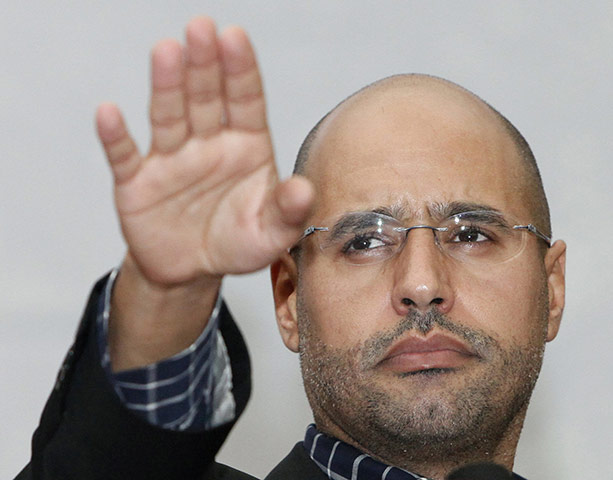
  Saif al-Islam - Photo: Ismail Zitouni/Reuters
Saif al-Islam Gaddafi, the son / spawn of Muammar Gaddafi, was captured yesterday near the southern Libyan oil town of Obari, as his armed companions were trying to smuggle him out of the country. The fact that he threw in the towel unlike his old man is currently being held in custody means that he might avoid an immediate and violent retribution for his crimes.

Oddly enough this news, as has been noted by the Independent on Sunday (20.11.11) may make some former grandees a tad twitchy. Saif al-Islam was Gaddafi’s heir and was feted in the West in his time. As a keeper of the regimes secrets and someone who was in the thick of brokering Gaddafi’s deal with the West his survival could be described in some circles as awkward.

Tony Blair, Lord Mandelson and other high rollers such as Oleg Deripaska and Nat Rothschild have all got links to Saif al-Islam. What may make this even more interesting is if he decides to blow the lid on the lot in court and call character witnesses, something that would be more difficult for those involved to avoid any trial takes place in the Hague.

The International Criminal Court (ICC) has a warrant out for Saif al-Islam arrest for crimes against humanity which could make things interesting. So far the Libyans as of yesterday were pretty determined that he would be put on trial in his own country to start with. The ICC is in contact with the Libyan Justice Ministry and one of its prosecutors would now fly to Tripoli for talks.

Mahmoud Shammam, the Libyan Information Minister, said: "This is the final chapter of the Libyan drama. We will put him on trial in Libya and he will be judged by Libyan law for his crimes." A guilty verdict and sentence of death in Libya would upstage any possible proceedings at The Hague and could lead to a number of UK based individuals breathing a deep sigh of relief - I wonder if any 'favours' will be called in? Watch this space!

Thursday, 20 October 2011

THUS SHOULD DIE ALL TYRANTS...

He won't be missed...save by his friends
The news that the Libyan ex-leader Col Muammar Gaddafi has been killed after fleeing an assault on his home town of Sirte will I suspect lead to the shedding of few tears for his passing. He may be missed by members of his family and his friends but by few other people. There will be more tears from the relatives of his victims and their surviving family members. Gaddafi may not have dodged the NATO bullets but he has successfully avoided a day in court at the Hague on War Crimes charges. Hopefully the National Transition Council will once its fully in-charge will publish any recovered paperwork relating to the supply or arms to the previous regime and hopefully have a full and public investigation into just who supplied the Libyan dictator with his weapons over the long and brutal years of his rule.

Saturday, 27 August 2011

KNOWING WHEN TO GO?

A potential visitor to the Hague War Crimes Tribunal and friend
There must come a moment in the 'politcal life' of 'a great leader' when they begin to lose the plot and any contact with real people (save for those telling you what you want to hear) becomes increasingly tenuous. Was it always about being the top dog, getting to the top of the greasy pole, getting to sit at the top table? Or was it always about lining ones pocket and siting pretty. Is the process gradual or seismic, or can said 'great leader' look back and pick the moment when any good being done was outweighed by the bad things being done.

Certainly of late we have seen 'great leaders' go from being favoured sons of the West to siting in a prison cell. For some dictators absolute power and endless overnight room service has been replaced with spending quality time with the slop bucket. And perhaps even more pleasingly having to keep a possible date in the Hague war crimes court in ones diary has become more prominent in a former great leaders diary than remembering peoples birthdays.

As a 'great leader' do you seek out 'Yes people' or is it something that happens around people who exercise power or run the shop? In the West (and in the UK) it has often been said that successful political leaders, regardless of their political hue, never quite know when to go.I have also heard it said that a political career always ends in failure. The long lingering departure of Tony Blair in 2006 / 2007 is a good case in point, a personal desire to clock up more time in office than Mrs Thatcher certainly overrode any political sense of reality, regardless of any electoral damage done to the Labour party.

Take Muammar Qaddafi, he overthrew the Libyan King Idris I (who was portrayed as puppet of the West (especially by Qaddafi after he took power), he was in power for 41 years, and until fairly recently was the longest-serving leader in both Africa and the Arab world. Having ceased power, in tail end of the Nasser era when the Arab great leader model was the height of fashion.

In the last 4 decades he has gone from handsome and charismatic young army officer to complete nutter and international pariah. Admittedly in this world being crazy and holding absolute power in a brutal dictatorship are not mutually exclusive, I mean who going to say no? The once smart uniforms have been replaced by (if I was being generous) a somewhat flamboyant dress-sense and gun-toting female bodyguards.

As bizarre as aspects of New Labour's policies were they have nothing on Gaddafi's political philosophy, as laid down in the Green Book. Gaddafi's green book which might be described if one was being particularly generous as a homemade alternative to both socialism and capitalism, with some aspects of Islam thrown in for good measure (the late Enver Hoxha (dictator of Communist Albania) would have been exceptionally envious).

Nominally Qaddafi created a political system known as the "Jamahiriya" or "state of the masses", in which power was supposedly held by thousands of "peoples' committees". In truth Qaddafi and his hangers on held and retained absolute power in a very centralised and authoritarian state and appear to have had few qualms when it came to hunting down their political opponents (and murdering them) at home or overseas.

There was a time when the West feted unpleasant brutal dictators because then were perceived as being anti communist or keeping the lid on a whole host of potential other problems. The Cold War has effectively been over since 1989, yet we in the West have carried on being nice to some pretty unscrupulous and brutal repressive regimes. After the Cold War was over various countries have been more than happy to sell arms to nasty repressive brutal regimes regardless of their human rights record e.g Saudi Arabia, Libya, Algeria, Indonesia, Egypt, etc.

I have absolutely no doubt if some of the dictators that have fallen in recent months had survived or had successfully fought of the challenge to their power then, then after a short interlude, they would be being quite happily wooed by governments and businesses from the West. I mean you can never have enough rubber bullets and ground attack aircraft can you? I suspect that Western leaders find it easier to deal with dictatorships than democracies. It's far easier to right of the Arab people as fundamentalists who are incapable to running their own democratic states, who need a firm authoritarian hand to rule them, etc.

If democracies successfully emerge across the Middle East, then things will be different, perhaps democratically elected Arab leader will remember just who exactly was no keen to support their oppressors. Not to mention exactly who was more than happy to tool them up with the rubber bullets, armoured land rovers, armoured cars, electric cattle prods and tear gas and all the other handy little things that dictatorships need to stay in power. On that thought, perhaps we will have to wait and see what emerges as the Arab spring moves through summer and into winter.