Monday, 31 January 2011

FREEDOM'S STRUGGLE

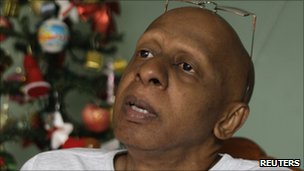
Guillermo Farinas
The struggle for freedom and democracy takes many forms, whether through acts of individual courage, as in totalitarian dictatorships like Communist Cuba, where Police in Cuba have again released leading dissident Guillermo Farinas after his third arrest in 48 hours. His latest arrest had come with around 10 other dissidents while laying flowers at a monument to Cuba's independence leader Jose Marti.

The BBC says that he was freed after being taken to hospital, complaining of chest pains. Guillermo Farinas gained international attention in 2010 when he came close to death after staging a 134-day hunger strike and was fed intravenously. He started his 23rd hunger strike in February 2010 in protest at the death of fellow dissident and hunger striker Orlando Zapata. This protest in July, when Cuban President Raul Castro authorised the release of 52 of the island's most prominent prisoners of conscience. The EU awarded him its Sakharov Prize for Freedom of Thought last December, although he was prevented from leaving Cuba to collect the award.

Sometimes, freedom, democracy and liberty can be affirmed at the ballot box, as is the case in South Sudan Preliminary results show that some 99% of South Sudanese have voted to secede from the north, according to the first complete results of the region's independence referendum. Some 99.57 percent of those polled voted for independence, according to the referendum commission. Early counting had put the outcome of the ballot beyond doubt, indicating Southern Sudan had secured a mandate to become the world's newest nation. The poll was agreed as part of a 2005 peace deal to end two decades of war. The final results from the 9th-15th January vote, which Sudanese President Omar al-Bashir has said he will accept, are expected early next month. If the result is confirmed, the new country is set to formally declare its independence on 9th July.

And sometimes, as in Tunis people have to stand up and be counted, when it really matters as they collectively brought an end 30 years of tyranny, corruption and wasted opportunities. Hopefully, the Egyptian people we be equally as successful as the Tunisian people were last month.

Sunday, 30 January 2011

GETTING ON WITH THE JOB

The one lesson that we should have learned by now is that we cannot rely on any Westminster Government to deliver for Wales. Let's electrify the Valley lines and the Ebbw Vale line (initially) into Cardiff by using some of the National Assembly's 0.78 billion transport budget. The Con Dem Westminster Government's has failed to stump up the cash for the electrification of the rail line between Swansea (originally only to Bristol) and London Paddington, a project that the last New Labour Government only considered in the last two years of Government (on occasion I do wonder what New Labour were doing in the previous eleven years at times), is disappointing. While we are at it, in the South East, we need railway stations at Caerleon and Magor and better facilities for passengers and more stopping services at Severn Tunnel, Chepstow and Abergavenny along with secure park and ride schemes and better integration of local bus services.

Saturday, 29 January 2011

GWENT POLICE BUDGET CUTS

News that Gwent Police are to face cuts of more than £24 million over the next four years is not good news. this is a direct consequence of the Con Dem Westminster government's recent comprehensive spending review, which as everyone knows has seriously slashed public spending across the board. Gwent Police are now going to be engaged in a prolonged bout of belt tightening as the force comes to terms with seriously reduced funding.

The South Wales Argus (27.01.2011), notes that Gwent Police will announce its budget plans on the 9th February, when some of the detail as to how the force will cut some £3 million in 2011/12 on top of potential savings of £7.6 million made in 2010/11. The budget for 2010/11 was set at £121.616 million. The Argus also notes that the outgoing Chief Constable Mick Giannasi stated that officer numbers would not be cut during this financial year. Gwent Police Authority members were told that while the official figure is £22 million, the force has to allow ten percent cushion for any alterations in costs so in reality the figure is £24.6 million.

Retention of police Officers, on and off the beat, and civilian support staff should be the bottom line. Once you go down the line of cutting civilian support staff, which some may consider an easier and slightly more acceptable situation than reducing police numbers, there will be consequences. A reduction in civilian support staff numbers will inevitably lead to a reduction in the availability of operational police officers, which will have consequences for all of us.

Policing, just like everything else is driven by funding - this is the reality of modern (and old time) policing, our hard pressed Police Service (whether in Gwent, South Wales, Dyfed-Powys or North Wales) all need additional funding and an increase in the number of serving officers. On top of that our Police Officers actively need the active support of our communities, especially if we are seriously going to deal with crime and anti-social behaviour and to ensure proper Policing within our communities.

Now there is absolutely no reason why we cannot be far more creative when it comes to how are Communities are policed. We certainly need a more flexible approach to shift patterns to tackle those periods of the day when higher levels of criminal offences take place and need to actually respond to local communities real concerns rather than the Ministry of Justice's (formerly the Home Office) perceived priorities and targets.

We need to avoid repeating the mistakes of the past when it comes to basing Policing strategies on core or periphery because the end result is that some of our our communities will lose out when it comes to access to Police services and resources. If we want to curb crime in Wales, then it makes sense for the control of Policing as well as Justice and Prisons within Wales to be fully devolved to the National Assembly, much of this already happens in Scotland, are we less capable than the Scots or less of a nation than Scotland? - I think not!

Friday, 28 January 2011

TIME TO DECLARE AN INTEREST?

Everybody is getting hit hard by the high fuel prices, if the Prime Minister breaks his promises on introducing a fuel duty stabiliser then the poorest in society suffering more than the rest of us. The Conservative Party promised to look into a "fair fuel stabiliser" in their election manifesto, in early January, David Cameron said he was considering ways to help cash-strapped motorists. More recently Cameron has played down the possibility of a "fair fuel stabiliser" to limit fuel duty rises. The fact that UK Government benefits to the tune of 600 million a week in fuel duty may be a contributory factor in relation to the PM’s indecision, just as it was with former New Labour PM, Gordon Brown, perhaps Mr Cameron should declare an interest?

There is an urgent need to see measures put in place to stabilise prices before they rocket even higher. Implementing a Fuel Duty Regulator would at least bring duty down when oil prices go up – and cap prices at the petrol pump. I think that there is little chance that Cameron will keep to his word or his election pledge on introducing a fuel duty stabiliser, as this UK Coalition Government seems to have shed any real principles as regularly as the snow melts in warmer weather.

The Federation of Small Businesses (FSB) says the UK now has the second highest diesel price in Europe - something which it says is causing great difficulties for hauliers and other businesses dependent on road transport. They point out that in Europe, the total price is split about 50/50 between the cost of the fuel itself and tax, yet, in the UK, the average product price is 38% of the total, with the remaining 62% coming from tax. Fuel duty already costs 58.95p for every litre. Average prices at the pump are now around 127p per litre and the Retail Motor Industry Federation has written to the Chancellor asking him to scrap the planned fuel duty increase, due in April.

Prices reached $147 a barrel before the recession in 2008 but are currently about $100 a barrel. The average price of petrol is rising at the highest rate for 10 years. The average cost of a litre of unleaded petrol has gone up by 6.13p since mid-December to a record 128.27p (£5.83 a gallon). The price of diesel is even higher and in some rural areas the cost of fuel is more than 20p a litre above the average figure. There are further increases in duty planned for April as well as expected rises in the price of oil. The 4th January VAT hike to 20% and a simultaneous rise in fuel duty, did little to help matters, as motorists saw 3.5p added to the cost of a litre.

Plaid Cymru has long favoured a new system of regulating tax on fuel in order to mitigate the effects of high prices at the pumps, and for a fuel duty regulator to cap the price of petrol at the pump when it rises too quickly. Wholesale oil prices will inevitably rise over the next few years as the world economy re-builds itself in the face of an increasing demand for oil and all of us will pay for higher fuel prices directly or indirectly. What's needed is an increase in sustained investment in renewable energy sources which would boost our economy without damaging the planet. It is scandalous that Wales was left out of recent pilot programmes for electric cars, but recent experience tells that for many Westminster Governments (Conservative or New Labour) Wales is so often out of sight and out of mind.

Thursday, 27 January 2011

MONMOUTHSHIRE SAYS YES

The official launch of the "Monmouthshire says Yes" campaign will be held tomorrow (Thursday) night, 27 January, at 7.30 pm in Trinity Church, Baker Street, Abergavenny. The key speakers will be Nick Ramsay, Conservative AM for Monmouth, and Huw Edwards, former Labour MP for Monmouth. Sadly I won't be there to support the launch as I will be at another meeting (Friends of the Earth) in Newport, we live in very interesting if very changed (for the better) times here in the South East.

Wednesday, 26 January 2011

AN END TO THE GREAT PFI RIPOFF?

This was not a headline I would have expected to be in the Daily telegraph:

PFI: £70m bill for schools that had to close

The Daily Telegraph has rather belatedly discovered that PFI (in England) costs a fortune and brings little medium of long term benefits to users who continue to pay through the nose for maintenance. What seems to have wound up the Daily Telegraph is the fact that at the very least three PFI schools which have been closed due to falling pupil numbers are still being paid for by education authorities (in England) who continue to pay the contractors millions of pounds each year for them until 2035. Additionally, and this must come as something of a shock to the Daily Telegraph, that dozens of other PFI schools which have been built and operated by the private sector, which rented back to the taxpayer regularly face high costs and “incredibly frustrating” restrictions which “hamstring” how they are able to use their school buildings.

Oddly enough the House of Commons’ Committee on Public Accounts which has backed Plaid Cymru’s stance on Private Finance Initiatives (PFI) on housing and hospitals. PFI was developed by the last New Labour government which involves private companies developing projects and paid back by the government over a long contract. Plaid has consistently criticised PFI projects for being costly to the taxpayer and poor in delivery. Right from the start Plaid said that Private Finance Initiatives were a New Labour trick which would eventually cost the taxpayer much more than if they were government-funded upfront. The Public Accounts Committee report has slammed PFI housing projects which have cost considerably more than originally planned and have been, on average, two and a half years late, and says that poor administration, rising costs and the well-known cunning of the financial services sector mean that taxpayers have not benefited from using this method of funding.

It's worth noting that the Plaid-driven One Wales Government confirmed back in 2007 that it would end PFI in the Welsh NHS as part of our goals of keeping the markets out of the health service. Previous reports have shown that PFI has failed when used in the defence sector and this Public Accounts Committee report says that there have been serious problems using it for building housing and hospitals in the NHS. Yet, despite this the UK Government persists in continuing blindly down this road, it's time to draw a line, its time to reconsider the best and most appropriate ways of funding new projects, especially as the Westminster Government is hell-bent on slashing the capital spending which was their core funding.

Further Telegraph revelations have revealed that existing PFI agreements, taxpayers are having to pay more than £200 billion for schools, hospitals and other projects whose capital value was little more than £50 billion. The is the price we are all having to pay (and pay again) for Blair and Brown's premierships – one questions I would like answered is where exactly was the Daily Telegraph when the rush to PFI was under-way? perhaps now that the Daily Telegraph has woken up to the expensive mess that excessive use of PFI has created then perhaps the Conservative part of the Con Dem Government will stop using PFI - perhaps not as it is rather popular with their friends in the City?

Tuesday, 25 January 2011

ON THE RIGHT LINES

Network Rail is looking at restoring services on the disused Amlwch branch line (on Anglesey) that closed to passenger traffic more than 35 years ago. The old line between Llangefni and Gaerwen shut in 1964 but remained in use for chemical freight until the early 1990s. The four-and-a-half miles (7.2km) of track will be subject to a feasibility study will see engineers looking at 31 bridge and culverts, as well as earthworks on the route. They will also examine the feasibility of refurbishing the Llangefni station building and its disused platform. This is good news - any chance that network Rail can have a look at the old line between Little Mill and Usk, with a view to similar feasibility study?