Showing posts with label Communist Dictatorship. Show all posts

Thursday, 20 August 2015

ONE-DAY IN AUGUST


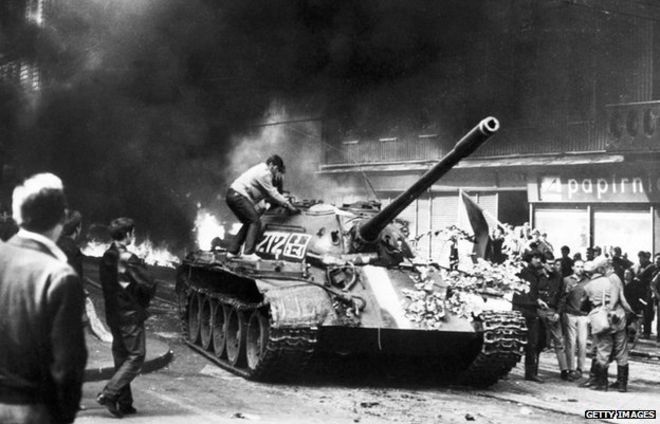
Friday 21st August 2015 is the 47th anniversary of the Soviet led invasion of Czechoslovakia.  It has been 45 years since Soviet troops and most of their Warsaw Pact allies invaded Czechoslovakia on August 21st 1968. The well-planned invasion aimed to crush the political and economic reforms known as the Prague Spring, led by the country's then new First Secretary of the Communist party Alexander Dubcek. Leonid Brezhnev and other Soviet hard-liners in Moscow saw the reform movement as a serious threat to the Soviet Union's hold on the Socialist satellite states, they decided to act. In the first hours on the 21st August 1968 Soviet planes began to land unexpectedly at Prague's Ruzyne airport, and shortly Soviet tanks would roll through Prague's narrow streets. The Soviet-led invasion helped establish the Brezhnev Doctrine, which Moscow said allowed the U.S.S.R. to intervene in any country where a Communist government was under threat. The Soviet backed occupation of Czechoslovakia lasted until the velvet revolution brought an end to the Communist dictatorship in November 1991 as the Cold War ended. Even now Russia’s attitude to the invasion can touch raw emotions, especially in the Czech and Slovak republics.

Saturday, 18 October 2014

TWENTY-FIVE YEARS AGO…

Some 25 years ago last week back in October 1989, amidst growing frustrations with East German style communist rule a wave of mass protests swept East Germany. Barely fifty years after East Germany was created in the Soviet occupied eastern Germany following the Second World War, these demonstrations would ultimately led to the fall of the Berlin Wall and the subsequent transformation of Europe.

During the Cold War there were around some 5,000 successful escapes to West Berlin, and many failed escape attempts. There is an on-going argument about how many people died trying to escape to freedom - according to the Center for Contemporary Historical Research (ZZF) in Potsdam there were 136 confirmed deaths. Where once people risked everything to cross the old border now you stroll from one half of the city to the other with barely a thought about it.


I remember clearly recall watching the protests on TV and keeping my fingers crossed and hoping that the tyranny would fall. Almost miraculously it did and from that moment onwards all things literally became possible, it is easy to forget that we live in a post cold war Europe were it is quite possible and entirely normal for the peoples like the Scots, the Catalans and others to seek self-determination

Thursday, 24 October 2013

Never Forget / Nikagda Nezabudem

Where once Rock kept the flame of resistance against Communist Dictatorship burning, now it's being mobilised to keep apathy at bay, least the reformed Communists win big in the forthcoming Czech elections. 


With only a few days to go before the Czech Republic's parliamentary elections, popular Czech rock bands played a free concert in Prague with a political message: get out and vote. The organizers gave the event a Russian name -- "Nikagda Nezabudem," or Never Forget -- as a warning that voter apathy could mean a disproportionately strong showing for the country's Communist Party, driven from power in 1989. 

(Source: RFE/RL)

Wednesday, 21 August 2013

FORTY FIVE YEARS ON

Prague 1968
It has been 45 years since Soviet troops and most of their Warsaw Pact allies invaded Czechoslovakiaon August 21st 1968, bringing a halt to the political liberalization process known as the Prague Spring. The carefully orchestrated invasion was designed to crush the period of political and economic reforms known as the Prague Spring, reforms led by the country's new First Secretary of the Communist party Alexander Dubcek. 

The reform movement was viewed by Leonid Brezhnev and other Soviet hard-liners in Moscow as a serious threat to the Soviet Union's hold on the Socialist satellite states, they decided to act. In the first hours on the 21st August 1968 Soviet planes began to land unexpectedly at Prague's Ruzyne airport, and shortly Soviet tanks would roll through Prague's narrow streets. Within hours foreign troops would take up strategic positions throughout the city, including surrounding the building of the Central Committee of the Communist Party, taking hold of Wenceslas Square, and eventually taking over Czechoslovak radio and television. Around 500,000 troops invaded and occupied Czechoslovakia in an operation code-named "Danube." 

Some 500 Czechoslovaks were wounded and 108 killed in the invasion, which successfully ended political and economic reforms under the leadership of Alexander Dubcek and gave the Communist Party greater authority. The Soviet-led invasion helped establish the Brezhnev Doctrine, which Moscow said allowed the U.S.S.R. to intervene in any country where a Communist government was under threat. The Soviet backed occupation of Czechoslovakia would last until the velvet revolution brought an end to the Communist dictatorship in November 1991 as the Cold War ended.

Friday, 12 October 2012

THIS LAND IS NOT FOR SALE

It can be argued that in the end with people that it comes down to land, who lives on it, who owns it, what we do with it and what other people want to do with it. The issue of land tenure, land rights and land use is set to become one of the dominant issues of this century. This is an important issue that affects people in both the developed and the developing world as local people and local resources (including land) come under increased pressure from various levels of Government for development.

Forced evictions
An Amnesty International report states that forced evictions in China have risen significantly in recent years as local communist party officials sell off land to property developers, out from under the people living on it.  Amnesty International reports that many cases involve violence and harassment, and amount to “a gross violation of human rights". Local officials are under pressure to meet economic goals and vested interests are behind the coercion, the report noted.

The problem of security of tenure for farmers and local people is made worse by the fact that all land in the Peoples Republic of China (PRC) is effectively controlled by the state, and laws allow local governments to claim land for urban development projects. The on-going evictions are a serious cause of ongoing social discontent and resulted in public protests across the country. Communist Party local authorities are seizing and selling off land to pay back funds borrowed to finance stimulus packages during the economic downturn.

The PRC Communist Government promotes officials who deliver growth regardless of the cost, and the development of roads, factories, residential complexes on seized lands delivers visible results. Amnesty International has reported that the system is open to abuse and evictees often received little notice, no consultation and barely a fraction of the value of their land and homes in compensation.

There have been a number of violent clashes between local people and police or private security guards across different areas of China.  Amnesty International has interviewed lawyers, housing rights activists and academics, in and outside China. Standing Their Ground (an 85-page report) has looked at 40 cases of forced eviction (between January 2009 to January 2012), nine of which it said resulted in the deaths of people who were resisting being evicted.

Peoples resistance in Wukan
There have been some successful localised resistance to some of the evictions, Amnesty notes the example of Wukan village (in Guangdong province in 2011), here local residents demonstrated on the streets after a village negotiator protesting against local officials over a land grab died in police custody.


The protests resulted in the removal of two local Communist Party officials and the punishment of others in 2012. Local villagers also won the right to fresh local elections as part of the deal.

Amnesty suggests that any optimism in relation to the Wukan case may be premature might be premature, as so far there has been no independent investigation into the death of Xue Jinbo ( the village negotiator). Also villagers have still not got any of their land back. There are also reports that Communist authorities are harassing and spying on local activists in Wukan. The Communist Dictatorship does nominally have laws in place to protect farmers and local residents, but these are often ignored by Communist Party officials at local level.

Communist Party Leaders in Beijing have acknowledged the problem exists and are pledged to improve the situation. Amnesty International has called on the PRC to put an immediate stop to all forced evictions and ensure safeguards were put in place in line with international law. Amnesty also has urged the PRC to implement new regulations (that it adopted in 2011) which should provide for proper land compensation and outlaw the use of violence in these cases.
Friday, 27 July 2012

CUBAN DISSIDENTS FREED

Police in Cuba have freed a group of dissidents they had arrested on Tuesday at the funeral of the prominent activist Oswaldo Paya. Pressure group the Cuban Commission for Human Rights and National Reconciliation said most of those arrested had been freed, but the group did not give exact numbers. The dissidents were picked up for questioning by police after shouting slogans against the government. The dissidents were arrested (last Tuesday) as they were leaving the church where Oswaldo Paya's funeral service had been held.

Pswaldo Paya's funeral (Associated Press)
Mr Paya (aged 60) died in a car crash on Sunday. His son, Oswaldo, suspected that the car may have been forced off the road. Mr Paya alleges that two survivors of the crash said they had been forced off the road by a truck that rammed their car repeatedly.

Cuban officials say the driver, a Spanish national, lost control and hit a tree. Diplomats have told Reuters news agency there is no evidence to back Mr Paya's allegations and that they believe it was a genuine accident.

Oswaldo Farinas staged hunger strikes to draw attention to the plight of political prisoners in Cuba. In 2010 he received the Sakharov Prize, the European Union's human rights award for the second time having previously won in 2002. He was the founder of the Varela project, a campaign (begun in 1998) to gather signatures in support of a referendum on laws to guarantee civil rights. In May 2002, Cuba's National Assembly was presented with a petition of more than 10,000 signatures calling for an end to four decades of one-party rule. The Cuban government described Mr Paya as an agent of the US who was working to undermine the country's revolution.

Sunday, 18 December 2011

VACLAV HAVEL (1936 - 2011)

Vaclav Havel 1936 - 2011
News that Vaclav Havel, the Czech Republic's first president after the Velvet Revolution against communist rule, has died at the age of 75 will sadden many and bring back memories of the revolutions that swept Eastern Europe in the autumn of 1989. Havel a former dissident playwright, had suffered from prolonged ill-health, died this (Sunday) morning. Havel was born in 1936 to a wealthy family in Czechoslovakia and as a result was a marked man, considered by the Communist authorities as "too bourgeois", he was banned from going to University, so he studied at night school. He wrote, had his writing banned and his plays forced underground after the 1968 Prague Spring. He first came to international prominence as a dissident playwright in the 1970s through his involvement with the human rights manifesto Charter 77. In 1977, he co-authored the the Charter 77 movement for democratic change and faced along with other prominent dissidents near constant harassment. Havel was imprisoned and became Communist Czechoslovakia's most famous dissident and refused to compromise with the Communist authorities. Havel given the choice by the Communists, refused to leave the country preferring to stay and continue the struggle against Communist tyranny. Havel and the charter 77 dissidents were heavily involved in the successful velvet revolution in November 1989 which saw the effective peaceful demise of the Communist dictatorship. He was elected as Czechoslovakia's first post-communist president in December 1989. Havel successfully oversaw the difficult transition from authoritarian communism to democracy, and presided over the "velvet divorce" which saw the peaceful creation of the Czech Republic and Slovakia in 1993. Havel, left office in 2003 and continued writing. He died at his country home north-east of Prague.

Monday, 28 March 2011

CUBA AND POLITICAL PRISONERS

Despite the fact that the Cuban government is still in a state of denial when it comes to whether or not they actually hold political prisoners and basically considers dissidents as mercenaries in the pay of the US in order to destabilise the government. Despite this the Cuban Communist government has finally freed the last two political prisoners detained since a major crackdown on opposition activists in 2003. Felix Navarro, 57, was a teacher and political activist; 40-year-old Jose Ferrer a fisherman and member of one of the opposition movements. They were both sentenced to 25-year jail terms and considered prisoners of conscience by Amnesty International.

In all some 75 leading intellectuals, opposition figures and activists were detained during what became known as Cuba's "Black Spring". The Communist Dictatorship was exposed to widespread international condemnation at the mass arrests and long prison terms, with even the European Union suspending all its co-operation programmes. Some of them were later released on health grounds. However, it was not until last July that there was a breakthrough when a deal was brokered by the Roman Catholic Church in which Cuba's President Raul Castro agreed to free the remaining 52. The majority had left with their extended families for Spain within a few months. This process came to a halt when a dozen of the dissidents refused to leave and go into exile, they demanded that they be allowed to return to their homes in Cuba.

The Cuban government anxious to get out of the public eye has gone well beyond its original pledge and allowed at least 60 other prisoners to go to Spain. Another eleven more are due to leave Cuba shortly, including the last man listed as a Prisoner of Conscience by Amnesty International. It was the death in prison in 2010 last year of the dissident hunger striker Orlando Zapata Tamayo that out Cuba back into the international Human Rights spotlight. The issue remained in the headlines after another dissident, Guillermo Farinas, also began his own prolonged hunger strike. Earlier this month the remaining Ladies in White and some of the released prisoners met at the house of one of the organisers intending to hold a short march. They were besieged by several hundred pro-government supporters chanting abuse and forcing them to stay indoors.

The EU is due to consider in the coming months whether to fully normalise relations with Cuba. Cuba remains a one party state and despite the release of dissidents, the authorities are continuing to harass opposition groups even though they appear to have little impact amongst ordinary Cubans. In relation to curbing dissent in line of what's been going on across the Arab world, I wonder how long it will be before access to the Internet is curbed in Cuba. Oddly enough at the moment Cuba has one of the lowest levels of Internet access and mobile phone ownership in the Americas, but social media, may well be slowly starting to have an impact.

Wednesday, 8 December 2010

GUESS WHO'S NOT COMING TO DINNER?

The award of the Nobel Peace Prize to the Chinese dissident Liu Xiaobo, who has repeatedly faced imprisonment and surveillance from the Chinese government and is currently serving an 11-year prison sentence for "subverting state power" - has rattled more than a few bars. Liu helped write the manifesto, Charter 08, calling for political change in China. The massacre in Beijing's Tiananmen Square in 1989 turned him into a Human Rights activist. As a result of his nomination for and his winning of the Nobel Award for his work on Human Rights there is a growing boycott of the award ceremony.

It's interesting to see who apart from China are not going to attend Friday's Nobel Peace Prize ceremony. Envoys from Russia, Kazakhstan, Colombia, Tunisia, Saudi Arabia, Pakistan, Serbia, Iraq, Iran, Vietnam, Afghanistan, Venezuela, the Philippines, Egypt, Sudan, Ukraine, Cuba and Morocco will so far all miss the event "for various reasons". By way of comparison only ten embassies were absent from the 2008 ceremony which honoured the former Finnish President and UN special envoy Martti Ahtisaari.

The interesting bit may well be the reason why they are not there – some have pretty dreadful human rights records, some are one party repressive totalitarian states (with enough imprisoned dissidents of their own – who don’t want to encourage other Human Rights campaigners a tad closer to home) and others are simply significant recipients of Chinese Foreign Aid. Literally the bullies and the bought! What's even more interesting is how many are portrayed as being our Allies (in the so called War On Terror) - oh the company that we keep!

Friday, 9 July 2010

CUBAN COMMUNIST CONCESSIONS

The news that the 52 prisoners who will be freed over the next few months is welcome news but clearly more needs to be done when it comes to Human Rights and Democracy in Cuba. The prisoners are the last remaining jailed members of the group of 75 opposition figures who were arrested in a mass government crackdown in 2003. 

The Cuban Communist authorities have repeatedly denied that they hold political prisoners, labelling them mercenaries paid by the United States to undermine the system. Yet this mass release of political detainees, by one of the world last remaining Communist dictatorships should be seen as a significant concession to sustained international pressure over human rights, and it should have some positive effects in relation to better relations with both the US and Europe.

However, it is important to remember that Cuba is still a Communist dictatorship that badly needs free democratic elections along with the lifting of the trade embargo that has done little but bring much hardship to the ordinary long suffering Cuban people.

No doubt, when the Communist dictatorship collapse and a free democratic Cuba emerges I have not doubt that we will discover that senior Party members have lived pretty high on the hog over the years - as was the case in East German and the Old Soviet Union.

The record of Human Rights violations despite Communist denials will I don't doubt turn out to have been far worse than we previously imagined. Despite that dark thought - the news of the staggered release of political prisoners is still a positive step forward, and hopefully all of the political prisoners will soon be free.

Thursday, 13 May 2010

TIME FOR A FREE CUBA

The other weekend (2nd May), largely unnoticed especially by the usually vocal yet sycophantic apologists for the repressive Cuban Communist dictatorship, who were somewhat understandably preoccupied with the final days of the Westminster general election, the wives and mothers of various political prisoners held in Cuba were finally allowed to hold their weekly protest for the first time in three weeks without being harassed.

Previously Communist Government supporters had blocked the women, known as Ladies in White, from marching on the previous two Sundays. It takes real courage to confront a dictatorship that imprisons without trial (well save for show trials) and detains people who dissent. Perhaps this is a beginning the Mothers of the Disappeared in Argentina and Charter 77 in old Czechoslovakia were small in number but managed to see out their respective dictatorships. 

The BBC notes that the archbishop of Havana had intervened on behalf of the women, stating that Cardinal Jaime Ortega said the Communist authorities had agreed to allow the marches during the month of May, after which they would review their decision. On Sunday 25th, the women were blocked from marching by government supporters who corralled them into a park, where they shouted insults at them for hours.

For some years the 'ladies in white', a group of wives of political prisoners in Cuba, have been courageously staging weekly marches in the capital Havana. On the 26th April they were blocked and taunted by government supporters, and finally led away to a police bus. The Cuban government has routinely described the dissidents as common criminals who were paid by the US to destabilise the country. 

Cuba (just in case our home grown niavatistas have forgotten) is a repressive Communist dictatorship, earlier this year on 18th March which happens to be the anniversary of the mass arrests in 2003, the majority of whom remain detained remain behind bars, there were protests. This year the anniversary would probably have passed unnoticed save for the death of Orlando Zapata Tamayo was the first Cuban activist to starve himself to death in protest in nearly 40 years.

Even the European Parliament was moved to vote to condemn his death. In response the state controlled Cuban media, ran with a series of highly critical articles which appeared on the front page of the official newspaper Granma almost every day since then the EU vote. The EU has ineffectually called for a policy of engagement and dialogue with the communist-run island, a policy that sits in stark opposite to the continuing US trade embargo.

The US trade embargo has only hurt the long suffering ordinary people most rather than the members and dependants of the Communist Government and its elite, needs to come to an end. There is a pressing need for free and fully democratic elections in Cuba - perhaps this last Communist dictatorship may yet be finally consigned into the dustbin of historywhere it belongs - either way the decision needs to be made neither by the US Government or the Communist Dictatorship, but, by the Cuban people themselves.

Thursday, 18 March 2010

TIME FOR CUBAN DEMOCRACY

On Wednesday Cuban police detained wives and mothers of political dissidents at a demonstration in the capital, Havana. Some 30 members of the "Ladies in White" were stopped as they marched alongside the mother of a prisoner who died last month after a hunger strike. They are demanding the release of some 50 government critics who are still being detained without trial after mass arrests in 2003.

The BBC understands that most of the women detained in Havana were released shortly afterwards. Orlando Zapata Tamayo was the first Cuban activist to starve himself to death in protest in nearly 40 years. The case of Zapata, who was declared a prisoner of conscience by Amnesty International, and led to significant international condemnation and calls for the immediate release of all Cuba's detained dissidents.

However, recently Cuba's Communist authorities by way of response to outside pressure and international bad publicity have gone on the offensive against dissidents at home and abroad. This protest was the third held this week by the Ladies in White (Las Damas de Blanca) to mark the anniversary of the crackdown in the one-party Communist state which began seven years ago and continues to this day.

The women were heckled by hundreds of well organised government supporters as they left a church in the Parraga neighbourhood with Reyna Luisa Tamayo, who alleges that her son was tortured in jail and that his death amounted to premeditated murder. Police officers and interior ministry agents later asked the women to end their march and take shelter in two government buses. After they repeatedly refused, several female officers moved in and put them on to the buses by force.

The Cuban government routinely describes the dissidents as common criminals who were paid by the US to destabilise the country. Thursday (18th March) is the anniversary of the mass arrests in 2003, the majority of whom remain detained remain behind bars. The anniversary would probably have passed unnoticed but for the death of Zapata, he adds. When the European Parliament voted last week to condemn his death, Cuba responded by launching a counter attack on the EU.

Highly critical articles have appeared on the front page of the official newspaper Granma almost every day since then. Police brutality in Europe was the latest headline, while racism, unemployment and poverty in Europe were others, our correspondent says. The EU has ineffectually called for a policy of engagement and dialogue with the communist-run island, a policy that sits in stark opposite to the continuing US trade embargo. In truth, the US trade embargo, which hurts the ordinary people rather than the Communist Government and its ilk, needs to come to an end.

There is a need for free and fully democratic elections in Cuba - perhaps this last Communist dictatorship may yet be finally consigned into the dustbin of history - either way the decision needs to be made neither by the US Government or the Communist Dictatorship, but, by the Cuban people.