Showing posts with label The Prague Spring. Show all posts

Thursday, 20 August 2015

ONE-DAY IN AUGUST


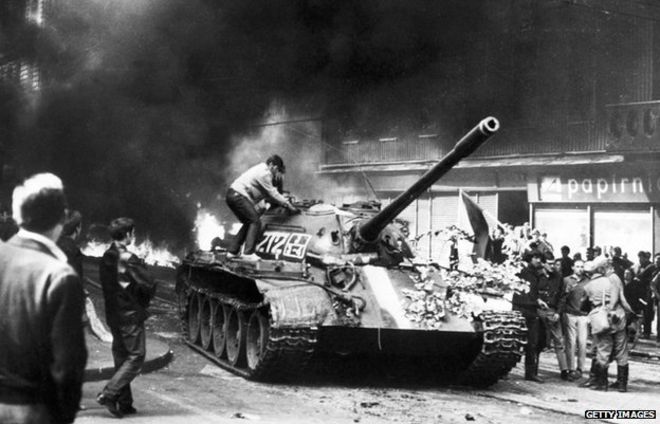
Friday 21st August 2015 is the 47th anniversary of the Soviet led invasion of Czechoslovakia.  It has been 45 years since Soviet troops and most of their Warsaw Pact allies invaded Czechoslovakia on August 21st 1968. The well-planned invasion aimed to crush the political and economic reforms known as the Prague Spring, led by the country's then new First Secretary of the Communist party Alexander Dubcek. Leonid Brezhnev and other Soviet hard-liners in Moscow saw the reform movement as a serious threat to the Soviet Union's hold on the Socialist satellite states, they decided to act. In the first hours on the 21st August 1968 Soviet planes began to land unexpectedly at Prague's Ruzyne airport, and shortly Soviet tanks would roll through Prague's narrow streets. The Soviet-led invasion helped establish the Brezhnev Doctrine, which Moscow said allowed the U.S.S.R. to intervene in any country where a Communist government was under threat. The Soviet backed occupation of Czechoslovakia lasted until the velvet revolution brought an end to the Communist dictatorship in November 1991 as the Cold War ended. Even now Russia’s attitude to the invasion can touch raw emotions, especially in the Czech and Slovak republics.

Wednesday, 21 August 2013

FORTY FIVE YEARS ON

Prague 1968
It has been 45 years since Soviet troops and most of their Warsaw Pact allies invaded Czechoslovakiaon August 21st 1968, bringing a halt to the political liberalization process known as the Prague Spring. The carefully orchestrated invasion was designed to crush the period of political and economic reforms known as the Prague Spring, reforms led by the country's new First Secretary of the Communist party Alexander Dubcek. 

The reform movement was viewed by Leonid Brezhnev and other Soviet hard-liners in Moscow as a serious threat to the Soviet Union's hold on the Socialist satellite states, they decided to act. In the first hours on the 21st August 1968 Soviet planes began to land unexpectedly at Prague's Ruzyne airport, and shortly Soviet tanks would roll through Prague's narrow streets. Within hours foreign troops would take up strategic positions throughout the city, including surrounding the building of the Central Committee of the Communist Party, taking hold of Wenceslas Square, and eventually taking over Czechoslovak radio and television. Around 500,000 troops invaded and occupied Czechoslovakia in an operation code-named "Danube." 

Some 500 Czechoslovaks were wounded and 108 killed in the invasion, which successfully ended political and economic reforms under the leadership of Alexander Dubcek and gave the Communist Party greater authority. The Soviet-led invasion helped establish the Brezhnev Doctrine, which Moscow said allowed the U.S.S.R. to intervene in any country where a Communist government was under threat. The Soviet backed occupation of Czechoslovakia would last until the velvet revolution brought an end to the Communist dictatorship in November 1991 as the Cold War ended.

Sunday, 18 December 2011

VACLAV HAVEL (1936 - 2011)

Vaclav Havel 1936 - 2011
News that Vaclav Havel, the Czech Republic's first president after the Velvet Revolution against communist rule, has died at the age of 75 will sadden many and bring back memories of the revolutions that swept Eastern Europe in the autumn of 1989. Havel a former dissident playwright, had suffered from prolonged ill-health, died this (Sunday) morning. Havel was born in 1936 to a wealthy family in Czechoslovakia and as a result was a marked man, considered by the Communist authorities as "too bourgeois", he was banned from going to University, so he studied at night school. He wrote, had his writing banned and his plays forced underground after the 1968 Prague Spring. He first came to international prominence as a dissident playwright in the 1970s through his involvement with the human rights manifesto Charter 77. In 1977, he co-authored the the Charter 77 movement for democratic change and faced along with other prominent dissidents near constant harassment. Havel was imprisoned and became Communist Czechoslovakia's most famous dissident and refused to compromise with the Communist authorities. Havel given the choice by the Communists, refused to leave the country preferring to stay and continue the struggle against Communist tyranny. Havel and the charter 77 dissidents were heavily involved in the successful velvet revolution in November 1989 which saw the effective peaceful demise of the Communist dictatorship. He was elected as Czechoslovakia's first post-communist president in December 1989. Havel successfully oversaw the difficult transition from authoritarian communism to democracy, and presided over the "velvet divorce" which saw the peaceful creation of the Czech Republic and Slovakia in 1993. Havel, left office in 2003 and continued writing. He died at his country home north-east of Prague.